
Best Camera for Entry Level Photography
1) Canon EOS R10 Mirrorless Camera
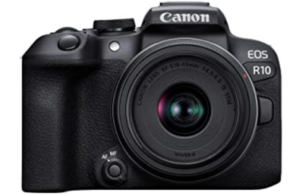
The Canon EOS R10 Mirrorless Camera is an outstanding entry-level option that blends powerful performance with beginner-friendly usability. At its core is the advanced DIGIC X image processor, which significantly boosts overall speed and responsiveness while delivering sharp photos and ultra-high-definition video quality. Paired with a 24.2MP APS-C CMOS sensor, the camera captures crisp, detailed images with impressive color accuracy; ideal for everything from portraits to landscapes.
One of the standout features of the EOS R10 is its lens compatibility, allowing users to pair it with Canon RF-S and RF lenses for optimal performance, or even EF/EF-S lenses using an adapter, making it highly versatile as you grow your gear. Action shooters will appreciate the high-speed continuous shooting capability of up to 15 frames per second with the mechanical shutter, ensuring you never miss fast-moving moments like sports or wildlife.
The camera’s smart and speedy autofocus system uses subject detection technology to lock onto and track subjects with impressive precision, keeping them in crystal-clear focus. Powering the camera is the LP-E17 battery pack, with convenient in-camera charging supported via a USB Power Adapter; perfect for on-the-go creators.
Framing and reviewing your shots is easy thanks to the vibrant anti-smudge LCD screen, which provides clear visibility even in bright conditions. Designed with portability in mind, the EOS R10 features a compact and lightweight build with a comfortable grip, making it ideal for travel and everyday photography. Out of the box, it comes ready to shoot with essential accessories including the RF-S 18–45mm lens, battery, charger, strap, and protective covers.
Pros
- Excellent image quality with 24.2MP APS-C sensor
- Fast DIGIC X processor for smooth performance
- Impressive 15 fps continuous shooting for action shots
- Reliable and intelligent autofocus with subject tracking
- Lightweight and compact; great for travel
- Wide lens compatibility (RF, RF-S, EF, EF-S with adapter)
- USB charging support for convenience
Cons
- Battery life could be better for extended shoots
2) Nikon Z50 II with Two Lenses
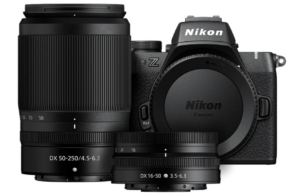
The Nikon Z50 II with Two Lenses is a versatile and beginner-friendly mirrorless camera kit designed to take your photography far beyond what a smartphone can offer. At its heart is a powerful 20.9MP DX-format (APS-C) sensor, which is significantly larger than a typical phone sensor, allowing it to capture lifelike colors, richer detail, and better low-light performance from sunrise to night scenes; all while maintaining a compact, travel-friendly design.
Creativity is front and center with the Z50 II, thanks to its Picture Control system. With the press of a button, you can choose from 31 built-in presets that instantly enhance your photos and videos. You can also create your own custom looks or download additional styles from Nikon Imaging Cloud, giving you real-time creative control as you shoot and helping you develop a unique visual aesthetic.
When it comes to focus, the camera excels with advanced subject detection autofocus, capable of recognizing and tracking nine different subject types; including people, animals like dogs and cats, birds, and even vehicles. Dedicated bird and airplane modes further enhance accuracy, making it a great option for wildlife and action photography.
Video creators will appreciate its powerful video capabilities, including 4K UHD at 60fps for crisp footage, as well as Full HD 120fps for smooth slow-motion shots. Built-in electronic vibration reduction (VR) helps stabilize your videos, while features like product review mode make it ideal for content creators and vloggers.
The Z50 II also includes a built-in flash, which is perfect for indoor and nighttime photography, offering balanced lighting and natural-looking portraits using Night Portrait mode. Sharing your work is seamless with the Nikon SnapBridge app, allowing you to transfer photos and videos instantly to your smartphone.
This kit stands out by including two versatile lenses: the NIKKOR Z DX 16–50mm f/3.5–6.3 VR for everyday shooting and the NIKKOR Z DX 50–250mm f/4.5–6.3 VR for zoom and distant subjects. Together, they cover a wide range of shooting scenarios; from landscapes and portraits to wildlife and sports; making it an excellent all-in-one package for beginners.
Pros
- Excellent image quality from 20.9MP APS-C sensor
- Wide creative control with 31 Picture Control presets + custom options
- Advanced subject detection autofocus (people, animals, vehicles)
- Strong video features (4K 60p and Full HD slow motion)
- Built-in flash for low-light and indoor photography
- Includes two versatile lenses for all shooting situations
- Easy wireless sharing via Nikon SnapBridge
Cons
- Limited native DX lens selection compared to some competitors
3) Sony Alpha a6400 Mirrorless Camera
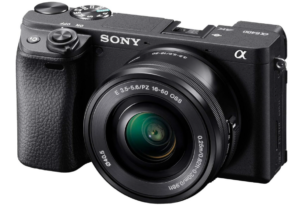
The Sony Alpha a6400 Mirrorless Camera is a compact yet powerful option for entry-level photographers and content creators who want speed, precision, and versatility. It features a high-resolution sensor paired with advanced imaging technology, delivering crisp, vibrant images with natural color reproduction. The camera is designed to perform exceptionally well in various lighting conditions, making it suitable for everything from portraits to travel photography.
One of its standout strengths is the enhanced subject capture system, which uses an impressive 425 phase-detection and 425 contrast-detection autofocus points covering approximately 84% of the sensor. This ensures fast, accurate tracking of subjects, whether you’re shooting people, action, or everyday moments. Complementing this is its high-speed continuous shooting capability of up to 11 frames per second, allowing you to capture sharp images in fast-paced situations without missing key moments.
For video creators, the a6400 offers multiple movie functions, including built-in time-lapse and slow/quick motion recording, eliminating the need for post-processing. The tiltable LCD screen adds flexibility, making it ideal for vlogging, selfies, or shooting at creative angles. Additionally, the camera includes essential accessories such as a rechargeable NP-FW50 battery, AC adapter, shoulder strap, and more; so you’re ready to start shooting right out of the box.
Pros
- Fast and highly accurate autofocus with wide coverage
- Excellent 11 fps continuous shooting for action photography
- Strong video features including slow motion and time-lapse
- Tiltable LCD screen ideal for vlogging and creative shooting
- Compact and lightweight design for portability
- Good image quality with natural color reproduction
Cons
- Battery life is relatively limited
4) Canon EOS R100 Mirrorless Camera
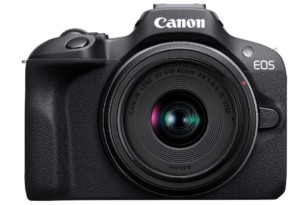
The Canon EOS R100 Mirrorless Camera is an excellent entry-level option designed for beginners who want to step up from smartphone photography without breaking the bank. It features a 24.1MP APS-C CMOS sensor, delivering stellar image quality with impressive clarity, rich detail, and natural background blur (bokeh). Whether you’re shooting portraits, landscapes, or everyday moments, the camera produces vibrant and professional-looking results.
One of its biggest advantages is its compact and lightweight design, making it the smallest and lightest camera in the EOS R series. This makes it perfect for travel, daily use, and creators who want portability without sacrificing performance. Powering the camera is the DIGIC 8 image processor, which enhances overall speed and enables smooth shooting performance along with 4K video capabilities; making it a solid starting point for those exploring interchangeable lens systems.
For video and action, the EOS R100 offers high-speed shooting options, including HD video at up to 120fps for slow motion, Full HD at 60fps, and 4K video at 24fps. Its advanced Dual Pixel CMOS autofocus system ensures sharp focus with wide coverage across 143 zones, including human face and eye detection, as well as animal and vehicle tracking. This makes it reliable for both still photography and video, with continuous shooting speeds of up to 6.5 frames per second in One-Shot AF mode.
Pros
- Excellent image quality with 24.1MP APS-C sensor
- Compact, lightweight, and highly portable design
- Affordable entry into the EOS R mirrorless system
- Reliable Dual Pixel autofocus with subject detection
- Solid video features including 4K and slow motion
- Easy to use for beginners transitioning from smartphones
Cons
- Limited 4K frame rate (max 24fps)
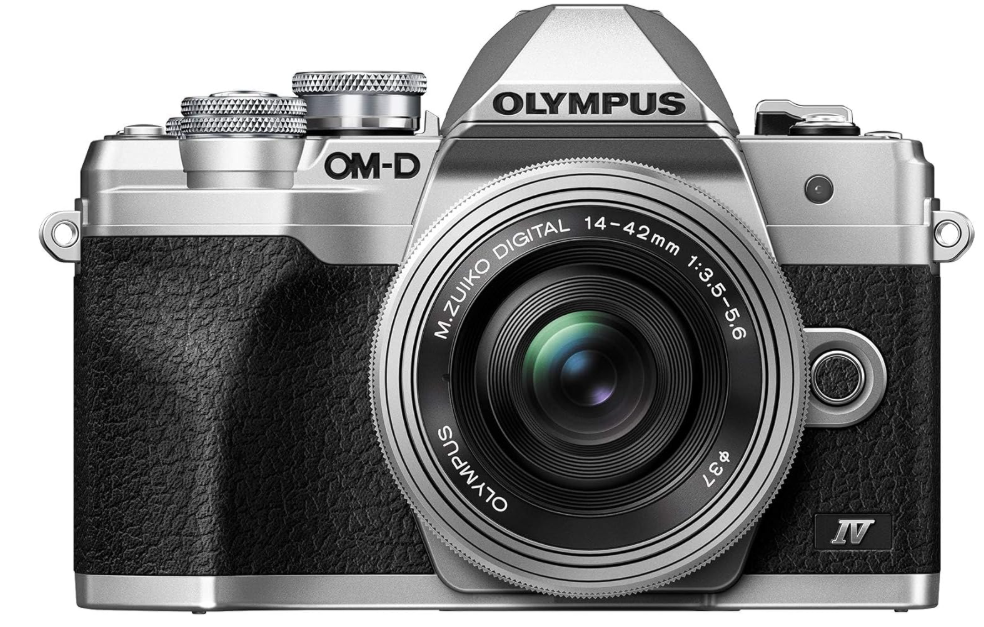
5) OM SYSTEM Olympus E-M10 Mark IV
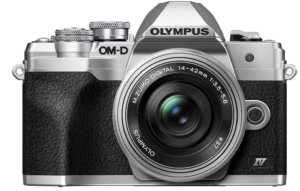
The OM SYSTEM Olympus E-M10 Mark IV is a stylish, compact mirrorless camera that delivers impressive performance for beginners and enthusiasts who value portability and creative control. At its core is a 20MP Live MOS sensor, which captures sharp, vibrant images with excellent detail and color accuracy; perfect for everyday photography, travel, and social media content.
One of its standout features is the in-body 5-axis image stabilization, offering up to 4.5 stops of compensation. This allows you to shoot handheld with greater confidence, even in low light or when using slower shutter speeds, resulting in clearer and sharper images without the need for a tripod. The camera also enhances connectivity with an always-on Bluetooth connection and seamless pairing via the OI Share smartphone app, making it easy to transfer photos and control the camera remotely.
For content creators and selfie lovers, the flip-down monitor with a dedicated selfie mode is a major plus. When the screen is flipped down, the camera automatically activates selfie mode, optimizing settings for flattering self-portraits and vlogs. Creativity is further expanded with 16 Art Filters (31 variations), including the new Instant Film effect that adds a nostalgic, vintage look to your shots straight out of the camera.
Despite its compact size, the E-M10 Mark IV offers flexibility with optical zoom up to 3x and digital zoom up to 2x, making it versatile enough for a range of shooting scenarios. Its lightweight build and retro-inspired design make it both functional and visually appealing; perfect for photographers on the go.
Pros
- Excellent in-body 5-axis image stabilization (great for handheld shooting)
- Compact, lightweight, and travel-friendly design
- Flip-down screen with dedicated selfie mode
- Strong connectivity with Bluetooth and smartphone app
- Creative flexibility with multiple Art Filters
- Good image quality from 20MP sensor
Cons
- Digital zoom reduces image quality
Factors to Consider When Choosing the Best Camera for Entry Level Photography
1. Sensor Size and Image Quality
The sensor is one of the most important parts of a camera because it directly affects image quality. Entry-level cameras like the Canon EOS R10 Mirrorless Camera and Canon EOS R100 Mirrorless Camera use APS-C sensors, which are significantly larger than smartphone sensors and produce sharper images with better detail and natural background blur (bokeh). A larger sensor also performs better in low-light conditions, making it ideal for beginners who want professional-looking results.
2. Ease of Use and Learning Curve
Beginner-friendly cameras should be easy to operate with intuitive controls and simple menus. Models like the Nikon Z50 II with Two Lenses and Canon EOS R100 Mirrorless Camera are designed with beginners in mind, offering guided modes, automatic settings, and helpful features that make learning photography less overwhelming. A camera that is easy to use will help you build confidence faster.
3. Autofocus Performance
A reliable autofocus system ensures your photos are sharp and well-focused, especially when shooting moving subjects. Cameras like the Sony Alpha a6400 Mirrorless Camera excel in this area with fast subject tracking and wide coverage. Features such as face, eye, and subject detection (including animals and vehicles) are especially useful for beginners who may struggle with manual focusing.
4. Continuous Shooting Speed
If you plan to shoot action, sports, or wildlife, continuous shooting speed (frames per second) is important. For example, the Canon EOS R10 Mirrorless Camera offers up to 15 fps, making it great for capturing fast-moving moments. Even as a beginner, having a camera that can keep up with action ensures you don’t miss important shots.
5. Video Capabilities
Many beginners today want a camera that can handle both photography and video. Cameras such as the Nikon Z50 II with Two Lenses and Sony Alpha a6400 Mirrorless Camera offer 4K video, slow motion, and vlogging features. If you plan to create YouTube content or social media videos, strong video performance is a big advantage.
6. Portability and Build
A lightweight and compact camera is easier to carry around, especially for travel or daily use. The OM SYSTEM Olympus E-M10 Mark IV and Canon EOS R100 Mirrorless Camera are great examples of portable designs that don’t compromise too much on performance. Beginners are more likely to practice and improve when their camera is easy to carry.
7. Lens Compatibility and Expandability
Choosing a camera with a wide range of compatible lenses allows you to grow as a photographer. Systems like Canon RF (used in the Canon EOS R10 Mirrorless Camera) and Nikon Z (used in the Nikon Z50 II with Two Lenses) offer flexibility with multiple lenses and adapters. This means you can start with a kit lens and later upgrade to specialized lenses for portraits, wildlife, or macro photography.
8. Image Stabilization
Image stabilization helps reduce blur caused by camera shake, especially in low light or when shooting handheld. Cameras like the OM SYSTEM Olympus E-M10 Mark IV offer in-body stabilization, which is highly beneficial for beginners. If a camera doesn’t have this feature, you may need lenses with built-in stabilization.
9. Connectivity and Sharing Options
Modern cameras should make it easy to transfer photos and videos to your phone or computer. The Nikon Z50 II with Two Lenses includes seamless sharing via the SnapBridge app, while others offer Bluetooth and Wi-Fi connectivity. This is especially useful for beginners who want to quickly share their work on social media.
10. Budget and Value for Money
Finally, your budget plays a major role in your decision. Entry-level cameras like the Canon EOS R100 Mirrorless Camera offer excellent value for beginners, while slightly more advanced options like the Sony Alpha a6400 Mirrorless Camera provide additional features at a higher price. The key is to balance cost with the features you actually need.