
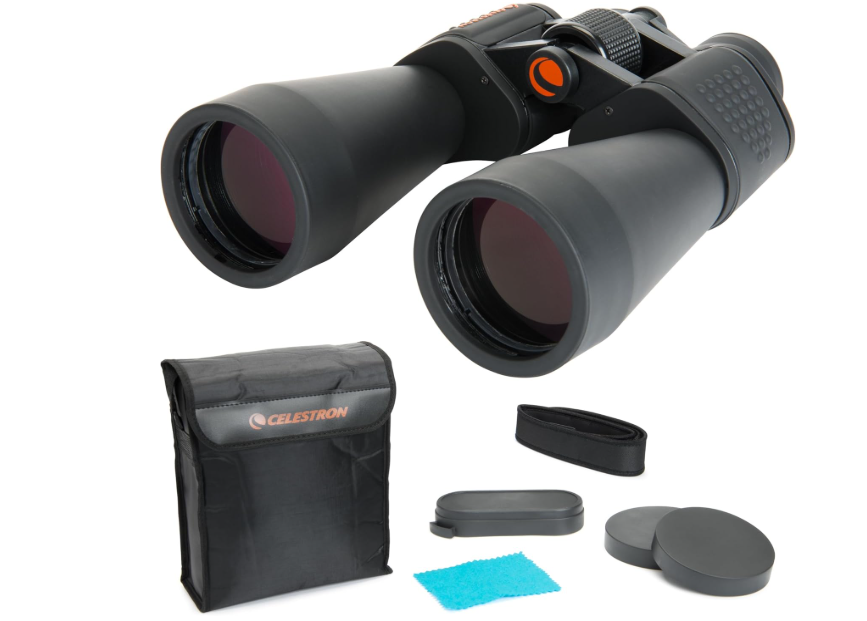
Getting started with stargazing doesn’t have to be complicated or expensive, and the right pair of binoculars can open up the night sky in a truly rewarding way. For beginners, binoculars offer a simple, portable, and affordable alternative to telescopes, making it easy to explore constellations, scan the Milky Way, and observe bright celestial objects like the Moon and star clusters.
Models with balanced magnification, large objective lenses, and quality optics; such as 7×50 or 10×50 configurations; provide bright, wide, and steady views that are perfect for learning the sky. Whether you’re a casual observer or just starting your astronomy journey, choosing the best beginner binoculars can make all the difference in how enjoyable and immersive your stargazing experience becomes.
Best Beginner Binoculars for Stargazing
1) Nikon ACULON A211 10X50
The Nikon ACULON A211 10×50 is a reliable entry-level binocular designed for users who want bright, clear, and wide views without spending too much. It features 10x magnification paired with large 50mm objective lenses, allowing excellent light gathering for brighter images; ideal for stargazing, wildlife viewing, and general outdoor use.
The binocular uses multi-coated optics and aspherical eyepiece lenses, which help improve contrast, reduce distortion, and deliver sharp images across the field of view. Its BaK4 Porro prism design enhances image brightness and depth, making objects appear more vivid even in low-light conditions like dawn or dusk .
In terms of build, the ACULON A211 offers a sturdy yet comfortable design with rubber armoring for a secure grip and a smooth central focusing system for quick adjustments. It measures approximately 19.7 cm in width and 17.9 cm in depth, with a weight of 900 g, giving it a solid feel in hand while remaining manageable for extended viewing sessions .
The interpupillary distance of about 5.6 cm (56 mm) ensures it can be adjusted to fit different users comfortably. While slightly bulky due to its Porro prism design, this contributes to its superior optical performance and wide field of view, making it an excellent choice for beginners looking for quality visuals at an affordable price.
Pros
- Bright and clear images thanks to 50mm large objective lenses
- Multi-coated optics improve contrast and color accuracy
- Wide field of view, great for stargazing and scanning skies
- Durable rubber-armored body with comfortable grip
- Excellent value for money for beginners
- Smooth central focus system for easy adjustments
Cons
- Not waterproof
2) Celestron – Cometron 7×50 Astronomy Binoculars
The Celestron Cometron 7×50 Astronomy Binoculars are designed as an easy-to-use and affordable entry point into stargazing, making them ideal for beginners who want to explore the night sky without investing in a telescope. Featuring 7x magnification, these binoculars provide a wide field of view (6.6°), allowing you to see a larger portion of the sky at once; perfect for scanning the Milky Way, observing constellations, and spotting large celestial objects like comets and star clusters.
The 50mm objective lenses combined with multi-coated optics enhance light transmission, delivering bright, detailed views with improved contrast even in low-light conditions, which is essential for astronomy .
Beyond stargazing, the Cometron 7×50 proves to be a versatile companion for daytime activities such as birdwatching, hiking, and scenic viewing, thanks to its close focus distance of 26.2 feet. Its tripod-adaptable design adds flexibility, allowing users to mount it on a tripod for stable, shake-free viewing during extended sessions.
The wide viewing angle also makes it easier for beginners to locate and track objects in the sky quickly. Backed by Celestron’s long-standing reputation in optics since 1960, these binoculars come with a limited lifetime warranty and reliable customer support, giving users confidence in their purchase. Overall, the Cometron 7×50 strikes a strong balance between performance, ease of use, and affordability, making it a solid choice for anyone starting their astronomy journey.
Pros
- Wide 6.6° field of view; great for scanning the night sky
- 7x magnification is steady and easy to use without shake
- Large 50mm lenses provide bright, clear images in low light
- Multi-coated optics improve contrast and detail
- Suitable for both day and night use
- Tripod adaptable for stable, long viewing sessions
- Affordable and beginner-friendly
- Backed by a solid warranty and customer support
Cons
- Lower magnification limits detailed views of planets
3) Nikon PROSTAFF P3 8×42 Binocular
The Nikon PROSTAFF P3 8×42 Binocular is a versatile and durable option designed for users who want crisp visuals, comfort, and reliability in all conditions. Equipped with large 42mm objective lenses, it gathers ample light to produce bright, sharp images even in low-light environments like dawn or dusk, making it perfect for birdwatching, hiking, sports events, and casual stargazing.
The binocular features advanced multilayer-coated lenses that reduce reflections while enhancing brightness and contrast, paired with a silver-alloy prism coating that delivers vivid, true-to-life colors across the visible spectrum. This results in a clear, vibrant viewing experience regardless of lighting conditions.
Built for outdoor use, the PROSTAFF P3 is weather-ready with O-ring seals and nitrogen gas purging, ensuring it remains fog-free and protected against water, humidity, and sudden temperature changes. Its construction uses fiberglass-reinforced polycarbonate with rubber armoring, offering a rugged yet lightweight design that feels secure and comfortable in hand.
For extended viewing sessions, it includes turn-and-slide eyecups and long eye relief, making it suitable for both eyeglass and non-eyeglass wearers. The smooth central focus wheel allows quick and precise adjustments, while the ergonomic design ensures balance and ease of use throughout the day. Overall, the Nikon PROSTAFF P3 8×42 stands out as a dependable, all-around binocular that blends optical performance with user-friendly comfort.
Pros
- Bright and sharp images, even in low-light conditions
- Multilayer-coated lenses improve clarity, contrast, and color accuracy
- Waterproof and fog-proof design for all-weather use
- Lightweight yet durable construction with a secure grip
- Comfortable for long use with adjustable eyecups and long eye relief
- Smooth and precise focusing system
- Great for multiple uses (birding, hiking, sports, light stargazing)
Cons
- Lacks tripod adapter in some kits
4) Celestron – Nature DX 8×42 Binoculars
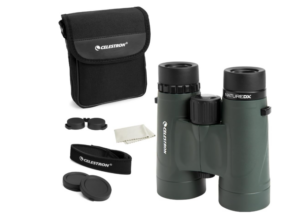
The Celestron Nature DX 8×42 Binoculars are built to deliver sharp, detailed views in a compact and lightweight design, making them an excellent choice for outdoor enthusiasts and beginners alike. With 8x magnification, these binoculars provide a steady and stable viewing experience while still allowing you to observe fine details in birds, wildlife, and distant landscapes.
The 42mm objective lenses strike a perfect balance between portability and brightness, ensuring clear and vibrant images without the bulk of larger binoculars. This makes them ideal for birdwatching, hiking, travel, and everyday adventures.
Optically, the Nature DX stands out with fully multi-coated lenses that maximize light transmission for brighter images, while phase-coated BaK-4 prisms enhance contrast and resolution, delivering crisp, true-to-life colors in various lighting conditions. The binoculars are designed to perform in the real world, featuring a rugged polycarbonate housing with rubber armor that protects against bumps and drops.
They are also waterproof and nitrogen-purged, preventing internal fogging and ensuring reliable performance in rain, snow, or humid environments. For added versatility, the binoculars are tripod-adaptable, allowing for steady, hands-free viewing during extended sessions (adapter not included). With a wide 7.4° field of view, tracking moving subjects like birds in flight or scanning large landscapes becomes effortless. Backed by Celestron’s trusted reputation and a limited lifetime warranty, the Nature DX 8×42 offers a dependable and high-quality viewing experience for a wide range of activities.
Pros
- Sharp, bright, and color-accurate images
- 8x magnification offers stable and detailed viewing
- Wide 7.4° field of view; great for tracking moving subjects
- Fully multi-coated lenses and BaK-4 prisms enhance clarity and contrast
- Lightweight and compact; easy to carry on adventures
- Waterproof and fog-proof for all-weather use
- Durable rubber-armored design for added protection
- Tripod adaptable for extended viewing sessions
Cons
- Limited low-light performance compared to larger objective lenses
5) Celestron SkyMaster 12×60 Binoculars
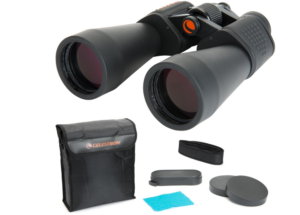
The Celestron SkyMaster 12×60 Binoculars are designed for users who want powerful magnification and enhanced brightness for long-distance and astronomical viewing. Featuring 12x magnification paired with large 60mm objective lenses, these binoculars gather a significant amount of light, making them ideal for observing distant landscapes, wildlife, and celestial objects like the Moon and star clusters.
The higher magnification brings subjects closer with impressive detail, while the large lenses help maintain image brightness even in low-light conditions such as dawn, dusk, or nighttime stargazing.
Optically, the SkyMaster uses BaK-4 prisms, which maximize light transmission to deliver bright, sharp, and more detailed images. This makes them especially popular among astronomy enthusiasts who need clarity in dim environments. Due to their size and weight, they can be used handheld for short periods, but for extended viewing sessions, they are tripod adaptable, allowing you to mount them on a standard photo tripod (not included) for a more stable, shake-free experience.
Built for durability, the binoculars feature a rubber-armored housing that protects against impacts while providing a secure grip, along with a water-resistant exterior that holds up well in challenging outdoor conditions. Backed by Celestron’s long-standing reputation and a limited lifetime warranty, the SkyMaster 12×60 is a dependable choice for users seeking powerful performance at an accessible price.
Pros
- Powerful 12x magnification for detailed long-distance viewing
- Large 60mm lenses provide bright images in low-light conditions
- BaK-4 prisms enhance clarity, brightness, and detail
- Suitable for both astronomy and terrestrial viewing
- Tripod adaptable for stable, extended use
- Durable rubber-armored body with a secure grip
- Water-resistant for outdoor reliability
- Backed by a strong warranty and customer support
Cons
- Not fully waterproof (only water-resistant)
Factors to Consider When Choosing the Best Beginner Binoculars for Stargazing
1. Magnification Power
Magnification determines how close objects will appear. For beginners, binoculars in the 7x to 10x range are ideal because they provide a good balance between detail and stability. Lower magnification like 7x offers a wider field of view and steadier images, making it easier to scan the night sky. Higher magnification such as 12x can reveal more detail but often introduces shakiness when used handheld, which can make viewing less comfortable without a tripod.
2. Objective Lens Size (Aperture)
The size of the front lenses, measured in millimeters (e.g., 50mm), plays a crucial role in how much light the binoculars can gather. Larger lenses like 50mm or 60mm allow more light in, producing brighter and clearer images; especially important for stargazing in low-light conditions. However, larger lenses also make binoculars heavier and less portable, so beginners should aim for a balance between brightness and ease of handling.
3. Optical Quality and Coatings
High-quality optics significantly improve your viewing experience. Features like multi-coated or fully multi-coated lenses help reduce reflections and increase light transmission, resulting in brighter and sharper images. Additionally, BaK-4 prisms are preferred over cheaper alternatives because they provide better clarity, contrast, and edge-to-edge sharpness, which is essential when observing stars and celestial objects.
4. Field of View
Field of view refers to how much of the sky you can see at once. A wider field of view is particularly beneficial for beginners because it makes it easier to locate and track objects like constellations, star clusters, and comets. Binoculars with lower magnification typically offer wider views, allowing for a more immersive and less frustrating stargazing experience.
5. Ease of Use and Stability
Beginner binoculars should be easy to hold and operate. Lightweight models with ergonomic designs and smooth focus wheels make extended viewing more comfortable. Stability is also key; binoculars that are too powerful or heavy can be difficult to keep steady, leading to blurred images. Models with lower magnification or the option to mount on a tripod can greatly improve usability.
6. Build Quality and Durability
Since binoculars are often used outdoors, durability is important. Look for features like rubber-armored housing for a secure grip and protection against drops. Weather-resistant designs, including waterproofing and fog-proofing (nitrogen purging), ensure the binoculars perform well in different environments such as humidity, rain, or cold temperatures.
7. Comfort and Eye Relief
Comfort is essential, especially for longer viewing sessions. Binoculars with adjustable eyecups and long eye relief are more comfortable to use, particularly for people who wear glasses. Proper interpupillary distance adjustment also ensures that both eyes align correctly with the lenses, providing a clear and strain-free viewing experience.
8. Portability and Weight
While larger binoculars provide brighter images, they are also heavier. Beginners should consider how and where they plan to use their binoculars. Lightweight and compact models (like 8×42) are easier to carry and handle, while larger models (like 10×50 or 12×60) may require more effort to transport and use, especially during long stargazing sessions.
9. Versatility (Day and Night Use)
Many beginner binoculars are designed to be versatile, meaning they can be used for both astronomy and daytime activities like birdwatching, hiking, or sports viewing. Choosing a model that performs well in multiple scenarios increases its value and usability, especially for beginners who want an all-around optic rather than a specialized tool.
10. Budget and Value for Money
Price is always an important consideration. Fortunately, there are many affordable beginner binoculars that offer excellent performance without a high cost. It’s best to focus on models that provide a strong balance of optical quality, durability, and ease of use within your budget, rather than simply choosing the cheapest option. Investing slightly more in a reputable brand can result in better long-term satisfaction.