
Table of Contents
ToggleThe best budget DSLR camera for vlogging allows you to create high-quality content without spending a fortune. Whether you’re starting a YouTube channel, sharing travel adventures, recording tutorials, or creating social media videos, an affordable DSLR offers impressive image quality, interchangeable lenses, and long battery life that many creators appreciate.
While mirrorless cameras have become increasingly popular, budget DSLRs remain a smart choice for beginners thanks to their reliable performance, intuitive controls, and excellent value. In this guide, we’ve rounded up the best budget DSLR cameras for vlogging, comparing their key features, strengths, and overall performance to help you find the perfect camera for your content creation journey.
Best Budget DSLR Camera for Vlogging
1) Canon EOS 250D/Rebel SL3
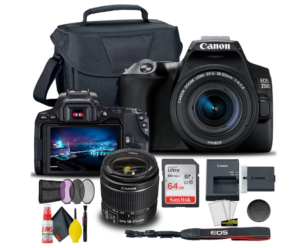
The Canon EOS 250D (Rebel SL3) is one of the best budget DSLR cameras for vlogging, offering an excellent balance of portability, image quality, and beginner-friendly features. As the smallest and lightest EOS DSLR in Canon’s lineup, it is easy to carry for travel, daily vlogging, and outdoor adventures without causing fatigue during long shooting sessions. Despite its compact size, it packs a powerful 24.1-megapixel APS-C sensor that captures sharp, detailed photos and records stunning 4K videos with vibrant colors and impressive clarity, making it ideal for YouTube, social media content, and family memories.
One of the camera’s standout features is its Dual Pixel CMOS Autofocus (AF) with Eye Detection AF, which delivers fast, smooth, and highly accurate focusing. Whether you’re filming yourself while walking, capturing moving subjects, or taking professional-looking portraits, the autofocus keeps your subject sharp and in focus with minimal effort. This makes the EOS 250D especially appealing to beginner vloggers who want reliable performance without needing advanced camera skills.
The 3.0-inch Vari-angle touchscreen LCD further enhances the shooting experience by allowing you to frame yourself easily for selfies and vlogs from virtually any angle. The responsive touchscreen also simplifies navigation through menus, changing camera settings, and selecting focus points with just a tap. Combined with its intuitive controls, the camera is incredibly user-friendly for creators transitioning from smartphones.
For added convenience, the Canon EOS 250D includes built-in Wi-Fi and Bluetooth, allowing you to transfer photos and videos wirelessly to your smartphone, control the camera remotely, and print images without cables. These connectivity features make it easy to share content quickly on social media or back up your files while on the go. Overall, the Canon EOS 250D (Rebel SL3) is an outstanding choice for beginners and budget-conscious content creators looking for a lightweight DSLR that delivers excellent image quality, dependable autofocus, and versatile vlogging features.
Pros
- Compact and lightweight DSLR that’s easy to carry.
- Excellent 24.1MP APS-C sensor for detailed photos.
- Records sharp 4K video with vibrant colors.
- Fast Dual Pixel CMOS AF with Eye Detection AF.
- Fully articulating 3.0-inch Vari-angle touchscreen.
- Built-in Wi-Fi and Bluetooth for wireless sharing and remote control.
- Beginner-friendly interface with intuitive controls.
- Excellent battery life compared to many mirrorless cameras.
Cons
- 4K video has a crop and limited autofocus performance.
2) Canon EOS Rebel T7
The Canon EOS Rebel T7 is an affordable entry-level DSLR that offers excellent image quality and simple controls, making it a great choice for beginner photographers and aspiring vloggers. At the heart of the camera is a 24.1-megapixel APS-C CMOS sensor, which captures sharp, detailed images with rich colors and records high-quality Full HD video.
Its ISO range of 100–6400, expandable to 12800, provides solid low-light performance, allowing you to shoot indoors or in dim lighting with reduced image noise. Whether you’re documenting everyday moments, creating YouTube content, or learning the basics of photography, the Rebel T7 delivers reliable performance at a budget-friendly price.
The camera features a 9-point autofocus (AF) system with AI Servo AF, helping maintain focus on moving subjects while delivering accurate results for portraits, landscapes, and casual action shots. While it isn’t as advanced as Canon’s Dual Pixel autofocus found on higher-end models, it performs well for general photography and beginner content creation. The optical viewfinder offers approximately 95% viewing coverage, providing a traditional DSLR shooting experience and making it easier to compose images even in bright outdoor conditions.
Sharing your photos and videos is simple thanks to the camera’s built-in Wi-Fi and NFC connectivity, which allows you to transfer files wirelessly to compatible smartphones and tablets for quick editing and social media uploads. An added bonus is compatibility with Canon’s EOS Utility Webcam software, enabling you to use the Rebel T7 as a high-quality webcam for video calls, online classes, livestreaming, and virtual meetings.
The camera also supports a wide range of Canon EF and EF-S lenses, giving users plenty of flexibility to expand their photography and videography skills as they grow. Overall, the Canon EOS Rebel T7 is an excellent budget DSLR for beginners seeking dependable image quality, lens versatility, and easy wireless connectivity.
Pros
- 24.1MP APS-C CMOS sensor captures sharp, detailed images.
- Beginner-friendly controls and intuitive interface.
- Built-in Wi-Fi and NFC for easy wireless file sharing.
- Reliable 9-point AF system with AI Servo AF.
- Optical viewfinder with approximately 95% coverage.
- Compatible with Canon EOS Utility Webcam software.
- Supports a wide range of Canon EF and EF-S lenses.
- Excellent value for first-time DSLR users.
Cons
- Records only Full HD (1080p) video; no 4K recording.
3) Nikon D3300
The Nikon D3300 is a budget-friendly DSLR that delivers impressive image quality and dependable performance, making it an excellent option for beginners, travel photographers, and casual content creators. It features a 24.2-megapixel DX-format CMOS sensor, which captures sharp, vibrant photos with excellent detail and natural color reproduction.
With an ISO range of 100–12,800, expandable to 25,600, the camera performs well in various lighting conditions, allowing you to shoot everything from bright outdoor landscapes to indoor scenes with minimal noise. Whether you’re documenting everyday moments or learning the fundamentals of photography, the D3300 offers image quality that exceeds expectations for its price.
The camera is capable of continuous shooting at up to 5 frames per second, making it suitable for capturing sports, wildlife, or other fast-moving subjects. Its 11-point autofocus system with 3D Tracking quickly locks onto subjects as they enter the frame and continuously tracks them to maintain sharp focus, helping you capture decisive moments with confidence. For video creators, the Nikon D3300 records Full HD 1080p video at frame rates of 60, 50, 30, 25, and 24 fps, providing smooth and detailed footage for family videos, travel content, and beginner YouTube projects.
Composing shots is easy thanks to the bright 3-inch LCD screen with 921,000-dot resolution, which offers a clear view for reviewing photos and navigating camera settings. The D3300 is compatible with a wide range of Nikon lenses, although AF-S lenses are required for autofocus, giving photographers plenty of room to expand their creative options as their skills develop. Overall, the Nikon D3300 combines excellent image quality, reliable autofocus, and solid Full HD video performance in a lightweight and affordable DSLR, making it one of the best entry-level cameras for new photographers.
Pros
- Excellent 24.2MP DX-format CMOS sensor for detailed images.
- Shoots up to 5 frames per second for action photography.
- Reliable 11-point autofocus system with 3D Tracking.
- Full HD 1080p video recording at up to 60 fps.
- Expandable ISO up to 25,600 for improved low-light shooting.
- Lightweight and compact DSLR design.
- Bright 3-inch LCD with high-resolution display.
- Compatible with a wide selection of Nikon lenses.
Cons
- Fixed LCD screen cannot flip for selfies or vlogging.
4) Nikon D5300
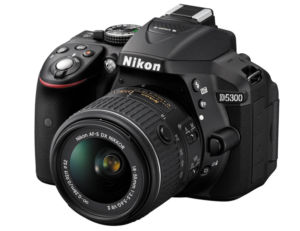
The Nikon D5300 is an excellent budget DSLR for photographers and beginner vloggers who want high image quality, advanced autofocus, and a fully articulating display without spending a fortune. It features a 24MP DX-format CMOS sensor with no optical low-pass filter, allowing it to capture exceptionally sharp images with rich detail and vibrant colors. Whether you’re photographing landscapes, portraits, or everyday moments, the sensor delivers impressive clarity and excellent dynamic range. Its ISO range of 100–12,800, expandable to 25,600, also provides solid low-light performance, enabling you to shoot confidently in challenging lighting conditions.
One of the D5300’s standout features is its 39-point autofocus system with 3D Tracking and 3D Matrix Metering II, which quickly locks onto subjects and maintains focus as they move across the frame. Combined with continuous shooting at up to 5 frames per second, the camera is well-suited for capturing sports, wildlife, and other fast-moving subjects. For video creators, the Nikon D5300 records Full HD 1080p video at 60p, 30p, and 24p, as well as 720p HD at 60p and 50p, producing smooth, detailed footage for YouTube videos, travel vlogs, and family memories.
The 3.2-inch Vari-angle LCD with 1,037,000-dot resolution makes composing shots from creative angles easy and is particularly useful for selfies, vlogging, and shooting overhead or at ground level. The camera also includes built-in Wi-Fi, allowing you to transfer photos wirelessly to your smartphone or remotely control the camera using a compatible device. Additionally, the integrated GPS automatically tags your images with location data, making it ideal for travel photography.
Support for RAW and RAW+JPEG shooting gives photographers greater editing flexibility, while compatibility with SD, SDHC, and SDXC memory cards ensures ample storage options. Overall, the Nikon D5300 is a versatile DSLR that combines excellent image quality, dependable autofocus, wireless connectivity, and a flip-out screen, making it one of the best budget DSLRs for photography and casual vlogging.
Pros
- Sharp 24MP sensor without an optical low-pass filter for maximum detail.
- Reliable 39-point autofocus system with 3D Tracking.
- Fully articulating 3.2-inch Vari-angle LCD screen.
- Records smooth Full HD 1080p video at up to 60 fps.
- Built-in Wi-Fi for wireless image transfer and remote shooting.
- Integrated GPS for automatic location tagging.
- Supports RAW and RAW+JPEG recording for advanced editing.
- Good low-light performance with expandable ISO up to 25,600.
- Shoots continuously at up to 5 frames per second.
Cons
- No 4K video recording.
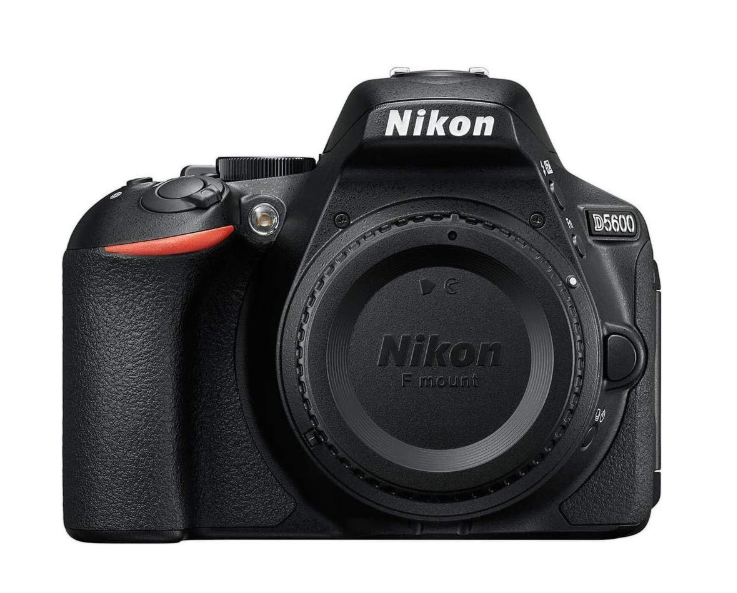
5) Nikon D5600
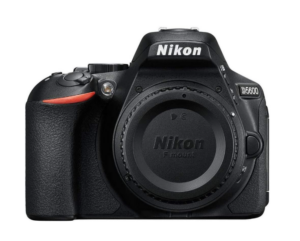
The Nikon D5600 is a versatile budget DSLR that combines excellent image quality, user-friendly controls, and modern wireless connectivity, making it an outstanding choice for beginner photographers and aspiring vloggers. At its core is a 24.2-megapixel DX-format CMOS sensor paired with Nikon’s powerful EXPEED 4 image processor, delivering sharp, vibrant images with accurate colors and impressive detail. Whether you’re capturing landscapes, portraits, travel adventures, or everyday moments, the D5600 consistently produces high-quality results with fast image processing and reliable performance.
One of the camera’s biggest highlights is its 3.2-inch Vari-angle touchscreen LCD with 1.037 million dots, which makes composing shots from virtually any angle effortless. The fully articulating display is especially useful for selfies, vlogging, overhead photography, and creative perspectives, while the intuitive touchscreen allows you to adjust settings, navigate menus, and select focus points with a simple tap.
For video creators, the Nikon D5600 records Full HD 1080p video at up to 60 frames per second, producing smooth and detailed footage for YouTube, travel vlogs, interviews, and social media content. The camera also supports video clips of up to 29 minutes and 59 seconds, making it suitable for longer recording sessions.
Staying connected is easy thanks to SnapBridge Bluetooth, built-in Wi-Fi, and NFC compatibility, allowing you to automatically transfer images to your smartphone, share content on social media, and remotely control the camera without complicated setup. Bluetooth 4.1 enables seamless background syncing, while Wi-Fi provides faster file transfers when needed.
Combined with its lightweight design, excellent image quality, and beginner-friendly interface, the Nikon D5600 is one of the best budget DSLRs for creators looking to step up from smartphone photography while enjoying the flexibility of interchangeable lenses.
Pros
- Excellent 24.2MP DX-format CMOS sensor produces sharp, detailed images.
- EXPEED 4 image processor delivers fast performance and vibrant colors.
- Fully articulating 3.2-inch Vari-angle touchscreen is ideal for vlogging and selfies.
- Records smooth Full HD 1080p video at up to 60 fps.
- SnapBridge Bluetooth enables automatic image transfers.
- Built-in Wi-Fi and NFC provide convenient wireless sharing and remote control.
- Responsive touchscreen simplifies camera operation.
- Lightweight and comfortable design for travel and everyday use.
- Excellent battery life for extended shooting sessions.
Cons
- No 4K video recording.
Factors to Consider When Choosing the Best Budget DSLR Camera for Vlogging
1. Image and Video Quality
The most important factor when choosing a budget DSLR for vlogging is the camera’s image and video quality. A DSLR with at least a 24MP APS-C sensor can produce sharp, detailed photos and high-quality videos with vibrant colors. If you plan to upload content to YouTube or other social media platforms, look for a camera that records at least Full HD 1080p, while 4K recording is an added advantage for creators who want higher-resolution footage. Better image quality gives your videos a more professional appearance and provides greater flexibility when editing.
2. Flip-Out or Vari-Angle Screen
A fully articulating or vari-angle LCD screen is one of the most valuable features for vloggers. Since you’ll often be recording yourself, a flip-out screen allows you to see exactly how you’re framed while filming, ensuring you’re always in focus and properly positioned. It also makes it easier to shoot from creative angles, take selfies, and capture overhead or low-angle shots without guessing your composition.
3. Autofocus Performance
Reliable autofocus is essential for creating smooth, professional-looking videos. Cameras with fast autofocus systems, such as Canon’s Dual Pixel CMOS AF or Nikon’s advanced autofocus systems with subject tracking, help keep your face or moving subjects sharp throughout the recording. Features like Eye Detection AF are particularly useful because they automatically maintain focus on your eyes, reducing the chances of blurry footage.
4. Portability and Weight
If you plan to vlog while traveling or filming outdoors, the size and weight of your camera matter. Compact DSLRs are easier to carry for extended periods and are less tiring when handheld. A lightweight camera also works better with small tripods, selfie sticks, and handheld gimbals, making it more convenient for creators who are always on the move.
5. Audio Recording Options
Great video quality should be matched with clear audio. A DSLR with a 3.5mm microphone input allows you to connect an external microphone, significantly improving sound quality compared to the camera’s built-in microphone. Clear audio helps viewers stay engaged and gives your videos a more polished and professional feel, especially when filming outdoors or in noisy environments.
6. Wireless Connectivity
Built-in Wi-Fi, Bluetooth, or NFC makes transferring photos and videos to your smartphone or computer quick and convenient. These wireless features also allow remote camera control through mobile apps, making it easier to start recording, adjust settings, or capture group shots without touching the camera. For content creators who frequently post on social media, wireless connectivity saves valuable time.
7. Battery Life
One advantage of DSLRs over many mirrorless cameras is their excellent battery life. If you regularly film long vlogs, travel videos, or events, choosing a camera with long-lasting battery performance means fewer interruptions and less need to carry multiple spare batteries. Longer battery life also makes the camera more reliable during full-day shooting sessions.
8. Lens Compatibility
A DSLR’s interchangeable lens system gives you room to grow as a creator. Entry-level DSLRs from Canon and Nikon support a wide variety of lenses, allowing you to upgrade from a standard kit lens to wide-angle, portrait, or telephoto lenses as your content evolves. Investing in a camera with an extensive lens ecosystem ensures you won’t outgrow it too quickly.
9. Low-Light Performance
Many vloggers record indoors, during evening events, or while traveling at night. A camera with a wide ISO range and good low-light performance can capture brighter, cleaner footage with less image noise. This allows you to produce high-quality videos without relying heavily on additional lighting equipment, making your setup simpler and more portable.
10. Ease of Use
A beginner-friendly camera can make the learning process much more enjoyable. Features such as intuitive menus, touchscreen controls, automatic shooting modes, and guided settings help new users become comfortable with DSLR photography and videography more quickly. As your skills improve, you’ll also appreciate having manual controls available for greater creative flexibility.
11. Continuous Shooting Speed
While continuous shooting speed is primarily important for photography, it can also benefit vloggers who capture action scenes, wildlife, sports, or behind-the-scenes content. A DSLR capable of shooting around 5 frames per second or faster allows you to capture fast-moving subjects with greater accuracy, increasing your chances of getting the perfect shot.
12. Value for Money
Finally, consider the overall value the camera offers within your budget. The best budget DSLR isn’t necessarily the cheapest model—it should provide a strong balance of image quality, autofocus performance, video capabilities, connectivity, battery life, and room for future upgrades. Choosing a camera that meets both your current and future content creation needs ensures you get the most from your investment without overspending.
FAQs
1. What is the best budget DSLR camera for vlogging?
The Canon EOS 250D (Rebel SL3) is widely considered the best budget DSLR camera for vlogging thanks to its compact design, 24.1MP APS-C sensor, 4K video recording, Dual Pixel CMOS autofocus with Eye Detection AF, and fully articulating touchscreen. It also includes a microphone input and built-in Wi-Fi and Bluetooth, making it an excellent choice for beginner and intermediate content creators.
2. Is a DSLR better than a mirrorless camera for vlogging?
It depends on your needs. Budget DSLRs offer excellent image quality, long battery life, and access to a wide range of interchangeable lenses, making them ideal for beginners. However, mirrorless cameras generally provide better video autofocus, in-body image stabilization, and more advanced video features. If you’re looking for an affordable camera with reliable performance and great value, a DSLR remains an excellent option for vlogging.
3. What features should I look for in a budget DSLR for vlogging?
When choosing a budget DSLR for vlogging, prioritize a flip-out or vari-angle touchscreen, fast autofocus, at least a 24MP APS-C sensor, Full HD or 4K video recording, and a microphone input for better audio quality. Built-in Wi-Fi or Bluetooth for wireless file sharing, good battery life, and compatibility with a wide selection of lenses are also important features that will improve your overall vlogging experience.
Read Also : Best DSLR Camera for Vlogging
Final Thoughts
The best budget DSLR camera for vlogging ultimately depends on your content style, experience level, and budget, but each camera featured in this guide offers excellent value for aspiring creators. Models like the Canon EOS 250D (Rebel SL3) stand out with their flip-out touchscreen, reliable autofocus, and 4K video capabilities, while options such as the Nikon D5600 and Nikon D5300 deliver outstanding image quality and versatile shooting features at an affordable price.
When making your choice, focus on key factors like video quality, autofocus performance, screen flexibility, battery life, and lens compatibility to ensure the camera meets your current and future needs. By investing in the right budget DSLR, you’ll have a dependable tool that helps you produce engaging, professional-looking vlogs and grow your audience with confidence.