
Table of Contents
ToggleFinding the right spotting scope for birdwatching does not have to mean spending a fortune. Whether you’re watching colorful birds across open fields, spotting wildlife from a distant trail, or trying to identify a rare species perched high in the trees, the best budget spotting scope for birding can bring those distant details remarkably close.
The challenge is knowing which features actually matter, from magnification and objective lens size to optical clarity, portability, weather resistance, and focusing performance. In this guide, we’ve explored some of the best budget-friendly spotting scopes for birding to help you find a model that delivers clear, detailed views without stretching your budget.
Best Budget Spotting Scope for Birding
1) Gosky Flagship DiamondEdge Spotting Scope
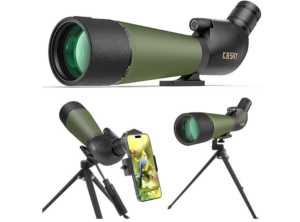
The Gosky Flagship DiamondEdge Spotting Scope is a versatile option for birdwatching, wildlife observation, hiking, camping, archery, scenery viewing, and even stargazing. It features a 20-60x variable magnification range and a dynamic lens focusing mechanism that allows smooth and precise adjustments when viewing subjects at different distances. This makes it easier to zoom in on distant birds and wildlife while maintaining a detailed view.
The scope is equipped with an 80mm fully multi-coated green film objective lens that provides a field of view of approximately 82.9–48 feet at 1,000 yards. Its high-quality BAK4 Porro prism enhances light transmission, helping produce brighter, clearer, and sharper images. The large objective lens also allows the scope to gather more available light, making it useful for observing birds and wildlife in varying outdoor lighting conditions.
Built for outdoor use, the Gosky DiamondEdge features a nitrogen-filled and sealed construction that provides waterproof and fog-proof protection. Its durable rubber-armored body offers a secure, non-slip grip while helping protect the scope against shocks and everyday outdoor wear. A stretchable eyepiece shield also provides additional protection for the lens during use and transportation.
Another useful feature is the included smartphone adapter, which allows users to capture photos and videos through the spotting scope. The adapter accommodates phones measuring approximately 2.13–3.54 inches (54–90 mm) wide and up to 14mm thick. This makes it possible to document bird sightings, wildlife encounters, landscapes, and other distant subjects without needing specialized photography equipment.
The scope comes with a full-metal tabletop tripod and mount for stable viewing from different angles. It also includes a carrying case, storage bag, lens and eyepiece covers, and a cleaning cloth, providing the essential accessories needed for transportation, protection, and maintenance. Overall, the Gosky Flagship DiamondEdge is a well-equipped spotting scope that combines powerful magnification, a large objective lens, durable weather-resistant construction, and smartphone compatibility, making it a practical choice for birders and outdoor enthusiasts.
Pros:
- 20-60x variable magnification
- Large 80mm fully multi-coated objective lens
- BAK4 Porro prism for improved light transmission
- Waterproof and fog-proof construction
- Durable rubber-armored body
- Includes smartphone adapter
- Full-metal tabletop tripod included
- Comes with useful carrying and cleaning accessories
- Suitable for birdwatching, wildlife viewing, hiking, camping, and stargazing
Cons:
- The 80mm objective lens makes it relatively bulky
2) Celestron Ultima 18-55×65 Angled Spotting Scope
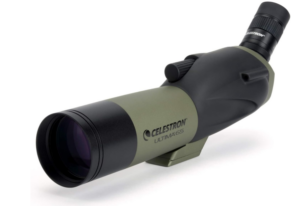
The Celestron Ultima 18-55×65 Angled Spotting Scope is a versatile all-around spotting scope designed for birdwatching, nature observation, and long-distance viewing. It features a 65mm objective lens, an 18-55x zoom range, and a comfortable 45-degree angled viewing design, making it a practical choice for outdoor enthusiasts who need flexible magnification without moving into a larger, heavier spotting scope. The angled configuration can also make extended viewing more comfortable, especially when the scope is mounted on a tripod.
One of its key strengths is its multi-coated optics. Every lens surface receives multiple layers of anti-reflective coating to improve light transmission, color, and contrast. This helps produce brighter and sharper images, particularly when ambient lighting is less than ideal. The 18-55x zoom eyepiece also gives users the flexibility to start at a wider field of view before increasing magnification for more detailed observations of distant birds, wildlife, landscapes, and other subjects.
The scope features a large focus dial that allows users to quickly bring distant subjects into sharp focus. This is particularly useful for birdwatching, where subjects can move unexpectedly and the ability to achieve sharp focus quickly is important. The included zoom eyepiece also has an integrated T-adapter for digiscoping, giving users the option of connecting compatible camera equipment to capture images through the scope.
Celestron also provides several useful accessories with the Ultima 65. These include a soft carrying case, extended tripod mounting plate, zoom eyepiece, eyepiece pouch, and lens cloth, helping make the scope easier to transport, set up, and maintain. The scope is backed by a Celestron Limited Lifetime US Warranty and US-based expert technical support, giving buyers additional peace of mind. Overall, the Celestron Ultima 18-55×65 is a capable option for birders and outdoor enthusiasts who want versatile magnification, good optical performance, and a comfortable angled viewing design.
Pros:
- 18-55x variable zoom provides versatile magnification
- 65mm objective lens balances light gathering and portability
- Comfortable 45-degree angled viewing design
- Multi-coated optics improve brightness, color, and contrast
- Large focus dial allows quick and precise focusing
- Integrated T-adapter supports digiscoping
- Includes carrying case and useful accessories
- Suitable for birdwatching, nature observation, and long-distance viewing
- Backed by Celestron’s Limited Lifetime US Warranty
Cons:
- 65mm objective lens gathers less light than larger 80mm+ scopes
3) Vortex Crossfire HD Spotting Scopes (16-48×65 Straight)
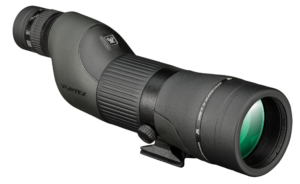
The Vortex Crossfire HD 16-48×65 Straight Spotting Scope is a value-focused optic designed for users who want dependable performance without paying premium prices. Its 16-48x magnification range provides flexibility for scanning wide areas and then zooming in for more detailed views, making it suitable for birdwatching, wildlife observation, and other long-distance viewing applications. The straight viewing configuration can also make it convenient for quickly locating and following subjects across open terrain.
At the heart of the Crossfire HD is an HD optical system that uses select glass elements to deliver improved resolution, color fidelity, and edge-to-edge sharpness while helping reduce chromatic aberration. Anti-reflective coatings are applied to all air-to-glass surfaces to increase light transmission, resulting in clearer images and better performance when lighting conditions become challenging. Its wide field of view is particularly useful for covering more ground and locating moving birds or wildlife more quickly.
The scope features a helical focus system that allows fast and precise focusing adjustments. Its adjustable eyecups can be twisted up or down to provide comfortable viewing whether you wear eyeglasses or not. The 65mm model also includes a built-in sunshade, which helps reduce glare and provides additional protection for the objective lens from rain and snow. An Arca-Swiss compatible foot allows the scope to mount directly onto compatible tripods, providing convenient setup straight out of the box.
Durability is another important feature of the Crossfire HD. Its shockproof rubber armor protects the scope from everyday bumps while providing a secure grip during outdoor use. The scope is also nitrogen purged, giving it waterproof and fogproof protection for reliable performance in changing weather conditions. Vortex backs the optic with its Unlimited, Unconditional, Lifetime VIP Warranty, which covers repair or replacement if the product becomes damaged or defective, excluding loss, theft, deliberate damage, and cosmetic damage that does not affect performance.
Pros:
- 16-48x magnification range for flexible viewing
- HD optical system provides sharp, high-resolution images
- Select glass elements help reduce chromatic aberration
- Excellent color fidelity and edge-to-edge sharpness
- Anti-reflective coatings improve light transmission and low-light performance
- Wide field of view helps with faster subject acquisition
- Helical focus allows fast and precise adjustments
- Adjustable eyecups work well with or without eyeglasses
- Built-in sunshade reduces glare and protects the objective lens
- Arca-Swiss compatible foot makes tripod mounting convenient
- Rubber armor provides shock resistance and a secure grip
- Nitrogen purged for waterproof and fogproof performance
- Backed by Vortex’s transferable VIP Lifetime Warranty
Cons:
- The 48x maximum magnification may be limiting for users who need extremely high-powered viewing
4) Celestron Ultima 20-60×80 Angled Spotting Scope
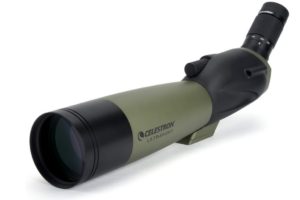
The Celestron Ultima 20-60×80 Angled Spotting Scope is a versatile long-distance viewing optic designed for birdwatching, nature observation, wildlife viewing, and other outdoor activities. It features a large 80mm objective lens, a 20-60x variable zoom, and a comfortable 45-degree angled viewing design. The combination gives birders plenty of magnification for examining distant subjects while the angled body makes extended observations more comfortable, especially when the scope is mounted on a tripod.
The scope uses multi-coated optics, with every lens surface receiving multiple layers of anti-reflective coatings to maximize brightness while improving color and contrast. The result is brighter and sharper imagery, even when ambient lighting becomes less favorable. The large 80mm objective lens is particularly useful for birdwatching because it can gather substantial light, helping users see more detail when observing birds at longer distances or during lower-light conditions.
A 20-60x zoom eyepiece provides flexible magnification, allowing users to scan a broad area at lower power before increasing magnification to examine distant birds and wildlife in greater detail. The large focus dial makes it easier to achieve sharp focus quickly, which is especially valuable when observing moving subjects. The zoom eyepiece also features an integrated T-adapter for digiscoping, allowing compatible camera equipment to be connected for capturing images through the scope.
Celestron includes several useful accessories with the Ultima 80, including a soft carrying case, extended tripod mounting plate, eyepiece pouch, lens cloth, and zoom eyepiece. These additions make the scope easier to transport, set up, and maintain in the field. The scope is also backed by a Celestron Limited Lifetime US Warranty and US-based expert technical support, providing additional confidence for buyers. Overall, the Celestron Ultima 20-60×80 is a strong choice for birders who want a large objective lens, powerful zoom range, comfortable angled viewing, and digiscoping capability in one package.
Pros:
- Powerful 20-60x variable magnification
- Large 80mm objective lens for strong light-gathering capability
- Comfortable 45-degree angled viewing design
- Multi-coated optics improve brightness, color, and contrast
- Large focus dial allows quick and precise focusing
- Integrated T-adapter supports digiscoping
- Suitable for birdwatching, wildlife observation, and long-distance viewing
- Includes carrying case and useful accessories
- Backed by Celestron’s Limited Lifetime US Warranty
Cons:
- Larger and heavier than spotting scopes with smaller objective lenses
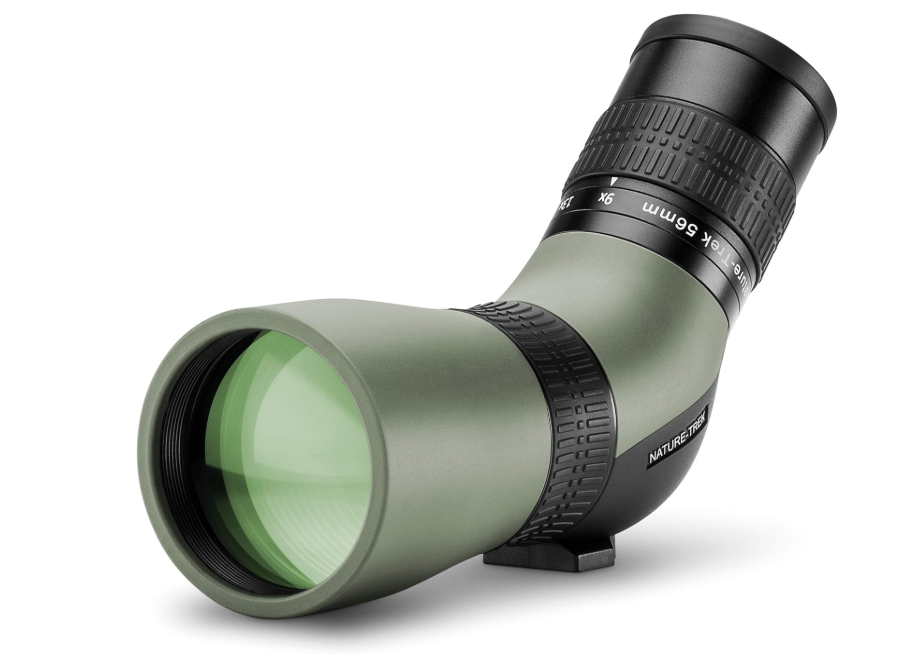
5) Hawke Nature Trek 9-27×56 Compact Spotting Scope
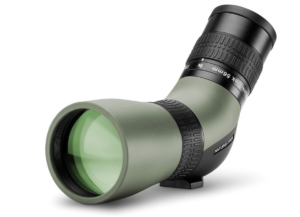
The Hawke Nature Trek 9-27×56 Compact Spotting Scope is designed for birdwatchers and outdoor enthusiasts who want a lightweight optic that is easy to carry without giving up useful viewing performance. Its ultra-compact and lightweight construction makes it particularly well suited to hiking, travel, and extended days in the field. The 9-27x magnification range provides flexibility for scanning nearby areas at lower power and zooming in when you need more detail on distant birds and wildlife.
The scope features fully multi-coated optics designed to produce sharp, clear images with good overall brightness and contrast. Its BAK-4 Porro prisms further enhance color and contrast, helping birders distinguish fine details and natural colors when observing birds and wildlife. This combination of multi-coated optics and quality prisms makes the Nature Trek a practical choice for everyday nature observation.
One of its standout features is its impressive close-focus capability of just 8.2 feet (2.5 meters). This allows users to examine nearby subjects in greater detail, which can be especially useful when watching birds at close range or observing insects, plants, and other natural subjects. The scope is also nitrogen purged for water- and fog-proof performance, helping it remain reliable when used in changing outdoor weather conditions.
Overall, the Hawke Nature Trek 9-27×56 Compact Spotting Scope is a good option for birders who prioritize portability, close focusing, and straightforward optical performance. Its compact design makes it easier to carry than larger spotting scopes, while the 9-27x zoom range provides enough versatility for many general birdwatching and nature observation situations.
Pros:
- Ultra-compact and lightweight design
- 9-27x magnification range for flexible viewing
- Fully multi-coated optics produce sharp images
- BAK-4 Porro prisms provide strong color and contrast
- Excellent 8.2-foot (2.5m) close-focus distance
- Nitrogen purged for water- and fog-proof performance
- Easy to carry for hiking, travel, and outdoor birding
- Well suited to close and medium-distance nature observation
Cons:
- 27x maximum magnification is lower than many full-size spotting scopes
Factors to Consider When Choosing the Best Budget Spotting Scope for Birding
1. Magnification Range
Magnification determines how closely you can examine distant birds. For birding, a scope with a variable zoom range such as 15-45x, 18-55x, or 20-60x provides useful flexibility. Lower magnification gives you a wider view for locating birds and tracking movement, while higher magnification allows you to study plumage, markings, and other details from farther away. However, maximum magnification is not everything; very high power can make it harder to keep moving birds in view and may require a sturdier tripod.
2. Objective Lens Size
The objective lens affects how much light the spotting scope can gather. Budget birding scopes commonly use objective lenses ranging from around 50mm to 80mm. A larger lens, such as the 65mm or 80mm objectives found on the Celestron Ultima and Gosky DiamondEdge, generally provides a brighter image and performs better in dimmer conditions. Smaller objectives are usually lighter and more portable, so your choice should depend on whether you prioritize optical performance or easy transportation.
3. Optical Quality
Good optical quality is essential because birdwatchers need to distinguish fine details and natural colors. Look for scopes with fully multi-coated or multi-coated optics, which help increase light transmission while improving brightness, contrast, and clarity. Quality glass and well-designed optical systems can also reduce chromatic aberration and produce sharper images, particularly toward the edges of the viewing area.
4. Prism Type
The prism system influences how efficiently light travels through the scope and contributes to overall image quality. BAK-4 prisms, found in scopes such as the Gosky DiamondEdge and Hawke Nature Trek, are a good feature to look for in a budget birding scope because they can provide strong light transmission, color reproduction, and contrast. For budget buyers, a scope with good prisms combined with properly coated optics can offer a significant improvement in viewing quality.
5. Field of View
A wide field of view makes it easier to locate birds and follow them as they move. This is particularly important for birding because birds can disappear quickly behind branches or move across an open area. Lower magnification generally provides a wider field of view, while increasing the zoom narrows it. Therefore, look for a scope that provides a good balance between wide-area scanning and detailed high-magnification viewing.
6. Close-Focus Distance
Close-focus distance is an important but sometimes overlooked feature for birdwatchers. A scope with a short minimum focusing distance allows you to observe birds and other wildlife that are relatively close to your position. For example, the Hawke Nature Trek 9-27×56 can focus as close as 8.2 feet (2.5 meters). This can be especially useful when watching birds in gardens, woodland areas, or other environments where subjects may appear at varying distances.
7. Portability and Weight
If you plan to hike long distances or carry your spotting scope on birding trips, size and weight should be major considerations. Compact models such as the Hawke Nature Trek are easier to transport, while larger 80mm scopes generally provide better light-gathering capability but add weight and bulk. Consider how often you will be carrying the scope versus using it from a fixed location before choosing between a compact and full-size model.
8. Focusing System
A good focusing system allows you to quickly achieve a sharp image before a bird moves out of position. Features such as a large focus dial or helical focus system can make precise adjustments easier. The Celestron Ultima scopes use a large focus dial, while the Vortex Crossfire HD features a helical focus system for fast and fine adjustments. For birding, smooth focusing is particularly valuable when tracking active or fast-moving subjects.
9. Weather Resistance
Birdwatching often takes place outdoors in changing weather, so waterproof and fog-proof protection can make a significant difference. Look for scopes that are nitrogen purged or nitrogen filled and sealed, as these features help prevent internal fogging and protect the optics from moisture. Rubber armor is another useful feature because it can improve grip while helping protect the scope from bumps and impacts during field use.
10. Viewing Angle
Spotting scopes are available in straight and angled configurations. A 45-degree angled scope, such as the Celestron Ultima models, can be comfortable for extended birdwatching and makes it easier to share the scope between users of different heights. Straight scopes can be quicker to aim and may be convenient for certain viewing positions. For general birding, an angled design is often worth considering if you’ll spend long periods observing from a tripod.
11. Tripod Compatibility and Stability
High magnification makes even small movements noticeable, so a stable tripod is essential for birding with a spotting scope. Check whether the scope has a standard tripod mount or an Arca-Swiss compatible foot, as found on the Vortex Crossfire HD. A scope may have excellent optics, but unstable mounting can make high-power viewing frustrating. If a tripod is included, also consider whether it is sturdy enough for the scope and your preferred magnification.
12. Digiscoping Capability
If you want to photograph or record the birds you observe, consider a spotting scope that supports digiscoping. Some models, such as the Celestron Ultima, include an integrated T-adapter, while the Gosky DiamondEdge comes with a smartphone adapter. Smartphone compatibility can be particularly appealing to budget-conscious birders because it allows you to capture sightings without immediately investing in a dedicated camera system.
13. Build Quality and Durability
A budget spotting scope should still be durable enough for regular outdoor use. Look for features such as rubber armor, shock resistance, waterproofing, and fog-proof construction. These features help protect the scope from accidental knocks and unpredictable weather. A durable body also makes the scope a better long-term investment, particularly if you regularly travel with it for birding trips.
14. Price and Overall Value
Finally, consider what you are actually getting for the price rather than choosing a scope simply because it has the lowest cost. A good budget spotting scope should offer a sensible combination of optical quality, magnification, durability, portability, and useful accessories. A slightly more expensive model may provide substantially better optics or weather protection and therefore offer better long-term value than the cheapest option.
FAQs
1. What magnification is best for a budget birding spotting scope?
A 20-60x magnification range is a versatile choice for budget birdwatching. Lower magnification makes it easier to locate and track birds across a wider field of view, while higher magnification allows you to examine distant birds and identify details such as plumage and markings. However, a scope with a lower range such as 9-27x can be preferable for close-range birding and portability.
2. Is an 80mm spotting scope good for birdwatching?
Yes, an 80mm spotting scope can be an excellent choice for birdwatching because its larger objective lens gathers more light, helping produce brighter images, particularly in dimmer conditions. Models such as the Celestron Ultima 20-60×80 and Gosky DiamondEdge 20-60×80 are suitable for birders who prioritize brightness and long-distance viewing. The trade-off is that 80mm scopes are generally larger and heavier than compact models.
3. Are budget spotting scopes good enough for birdwatching?
Yes, a good budget spotting scope can provide more than enough performance for recreational birdwatching. Models with multi-coated optics, BAK-4 prisms, useful magnification ranges, waterproof construction, and stable tripod compatibility can deliver clear and detailed views without requiring a premium investment. The key is to choose a scope based on your typical viewing distance, lighting conditions, portability needs, and optical quality rather than simply choosing the cheapest model.
Read Also : Best Compact Spotting Scope for Birding
Final Thoughts
Choosing the best budget spotting scope for birding ultimately comes down to finding the right balance between optical performance, magnification, portability, durability, and price. A good budget model should provide clear and bright images, enough magnification to observe distant birds, and a comfortable viewing experience in different outdoor conditions. Features such as multi-coated optics, BAK-4 prisms, weatherproof construction, smooth focusing, and tripod compatibility can make a noticeable difference in the field.
Whether you prefer the powerful 80mm Celestron Ultima, the versatile Gosky DiamondEdge, the durable Vortex Crossfire HD, or the compact Hawke Nature Trek, there are affordable options to suit different birding needs. With the right choice, you can enjoy detailed and rewarding birdwatching experiences without investing in an expensive premium spotting scope.