Finding the best budget deer hunting scopes means balancing optical clarity, dependable construction, a practical magnification range, and a price that leaves room in your hunting budget for other essentials. For most deer hunters using a standard centerfire rifle, a straightforward 3-9×40 scope is a sensible starting point. It offers a broad view at low power for wooded areas and enough magnification for careful aiming across a field.
However, not every affordable scope suits every hunting situation. A lightweight optic may be preferable for long walks, while a larger objective lens or illuminated reticle may help with certain dawn and dusk conditions. The important distinction is that these features do not automatically guarantee a brighter image or better performance.
This guide compares five budget-conscious hunting scope options, focusing on their intended uses, practical advantages, limitations, and the features worth considering before you buy. The emphasis is on conventional daytime deer hunting, with particular attention to hunters who want a useful, uncomplicated optic rather than expensive tactical features.
Quick Decision Table
| Product | Best For | Weight | Magnification | Key Advantage | Check Price |
| Bushnell Banner 2 3-9×40 | Traditional deer hunting | 14.8 oz | 3-9x | Simple hunting setup with QBR reticle | 👉 View on Amazon |
| Athlon Talos 3-12×40 BDC 600 IR | Hunters wanting illumination | 16.2 oz | 3-12x | Illuminated holdover reticle | 👉 View on Amazon |
| Primary Arms Classic 3-9×44 SFP Duplex | Basic, uncomplicated use | 18.4 oz | 3-9x | Simple duplex reticle and capped turrets | 👉 View on Amazon |
| Athlon Talos 3-12×40 Center X | Hunters preferring a conventional reticle | 16.2 oz | 3-12x | Extra top-end magnification without a holdover reticle | 👉 View on Amazon |
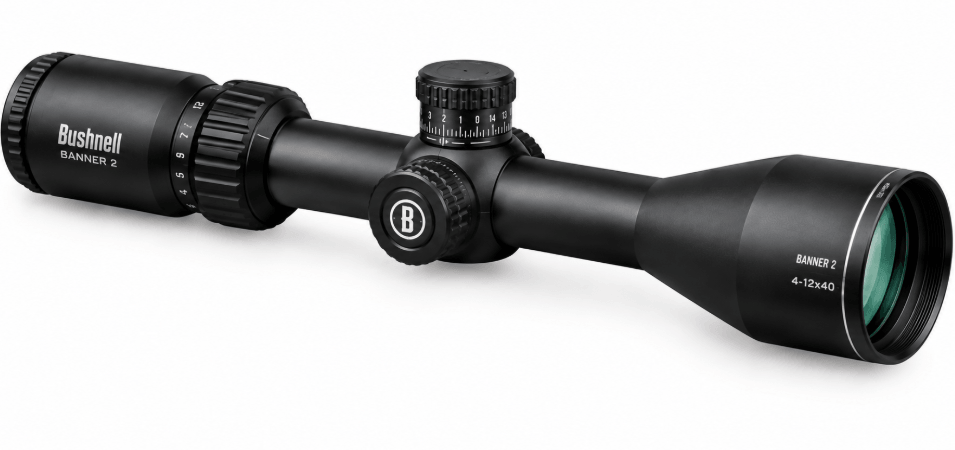
| Bushnell Banner 2 4-12×40 | More magnification for open terrain | 17.8 oz | 4-12x | Adjustable objective and higher maximum power | 👉 View on Amazon |
Quick Recommendations
Choose the Bushnell Banner 2 3-9×40 if: you want a conventional hunting scope with capped turrets and a practical magnification range.
Choose the Athlon Talos 3-12×40 BDC 600 IR if: you prefer an illuminated reticle and additional holdover references.
Choose the Primary Arms Classic 3-9×44 if: you want a simple duplex reticle and do not need illumination or a complicated adjustment system.
Choose the Athlon Talos 3-12×40 Center X if: you prefer a conventional reticle but want more magnification than a standard 3-9x scope provides.
Choose the Bushnell Banner 2 4-12×40 if: you hunt more open terrain and want a higher maximum magnification, accepting a narrower view at the upper end.
How These Products Were Chosen
The comparison focuses on features that affect ordinary deer hunting rather than specifications that look impressive on a product page.
The priorities are practical magnification, manageable weight, a reticle that is easy to use, useful eye relief, weather protection, and adjustment controls that are appropriate for a hunting rifle. A 3-9x scope is a strong starting point for hunters moving between timber and open fields, while a 3-12x or 4-12x model offers additional magnification for more distant viewing.
I also considered whether each model provides a meaningful alternative to the others. Illumination, reticle design, objective diameter, and parallax adjustment can all influence the buying decision, but more features do not automatically make a scope better for every deer hunter.
1. Bushnell Banner 2 3-9×40
Best for traditional deer hunting
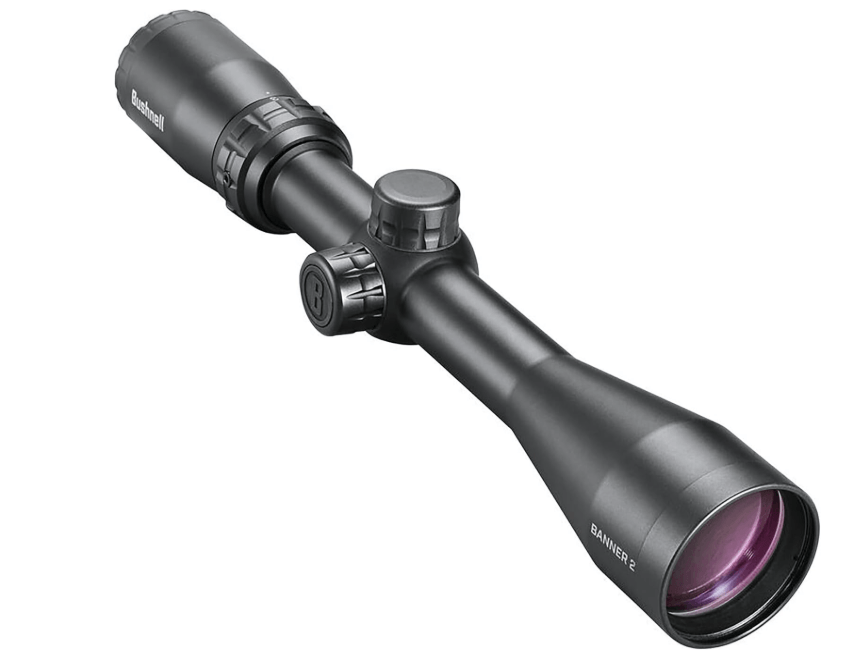
The Bushnell Banner 2 3-9×40 is a straightforward option for hunters who want a familiar magnification range and a conventional hunting-oriented setup. Its 3-9x configuration is well suited to comparing nearby woodland shots with more distant views across fields, without adding the bulk associated with many high-magnification scopes.
Why Choose It
The standard Banner 2 3-9×40 configuration uses a QBR reticle, capped turrets, and fixed parallax. These features suit buyers who want to establish their zero and leave the adjustment controls protected during ordinary hunting.
The QBR reticle includes reference points intended to assist with holdover. However, those references should not be treated as universal distance markings: their practical use depends on the cartridge, ammunition, sight-in conditions, and the reticle’s intended calibration.
Key Features
Magnification: 3-9x
Objective lens: 40mm
Weight: 14.8 ounces
Reticle: QBR
Turrets: Capped
Parallax: Fixed at 100 yards
Eye relief at maximum magnification: 3.5 inches
What These Features Mean in Real Use
At 3x, the scope provides a wider field of view than it does at 9x, helping you locate and observe a deer against its surroundings. At 9x, the increased magnification can help with careful aiming at a stationary, clearly identified animal within an appropriate shooting distance.
The 40mm objective provides a practical compromise between lens size and mounting height. Meanwhile, the 14.8-ounce weight is manageable for a hunting rifle that gets carried for extended periods.
The standard model’s 3.5-inch eye relief at maximum magnification deserves attention. Mount the scope so that you maintain a full sight picture without moving your eye dangerously close to the eyepiece, particularly with a recoiling centerfire rifle.
Trade-Offs
The fixed-parallax arrangement keeps operation simple but provides less flexibility than an adjustable system. The conventional configuration also lacks an illuminated reticle, which some hunters prefer when the reticle becomes difficult to distinguish against a dark background.
May Not Be Ideal If
You regularly shoot at varying distances that demand parallax adjustment, prefer a brightly illuminated aiming point, or need a specialized long-range reticle.
Pros
Practical 3-9x magnification range
Capped adjustment turrets
Moderate weight
Holdover references in the QBR reticle
Cons
No reticle illumination in the standard QBR version
Fixed parallax
Reticle references require proper calibration and understanding
Decision Summary
Best if: You want a conventional scope for ordinary deer hunting and prefer straightforward controls.
Consider another option if: Reticle illumination or adjustable parallax is important to your hunting style.
2. Athlon Talos 3-12×40 BDC 600 IR
Best for hunters wanting illumination
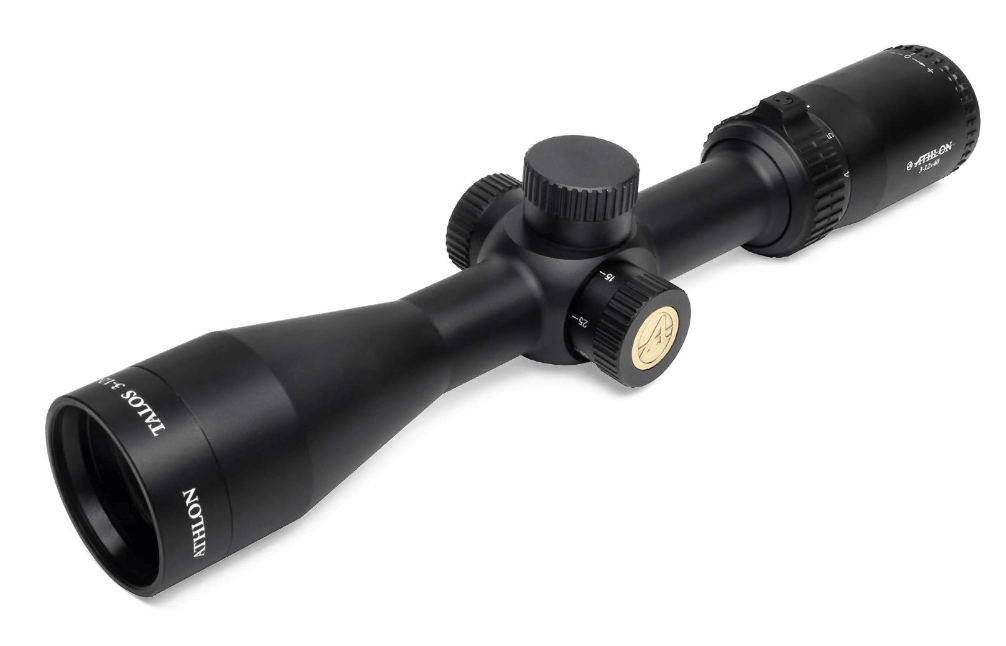
The Athlon Talos 3-12×40 BDC 600 IR offers more magnification than a traditional 3-9x scope, along with an illuminated ballistic-drop-compensating reticle. It is worth considering if you hunt a mixture of wooded areas and open ground and want additional flexibility when viewing distant animals.
Why Choose It
Its combination of 3-12x magnification and a BDC 600 IR reticle gives this model a different role from the simpler options in this list. Illumination can help make the reticle easier to distinguish against shaded vegetation, while the holdover references offer aiming points for different trajectories when properly matched to the ammunition and setup.
Athlon also specifies fully multi-coated optics and a sealed, nitrogen-purged construction designed to provide waterproof and fog-proof protection.
Key Features
Magnification: 3-12x
Objective lens: 40mm
Weight: 16.2 ounces
Reticle: BDC 600 IR, second focal plane
Tube diameter: 1 inch
Eye relief: 3.8 to 3.35 inches
Parallax: Side focus from 15 yards to infinity
Adjustment value: 0.25 MOA per click
Turrets: Capped
What These Features Mean in Real Use
The additional 12x maximum magnification can help you examine a stationary target at a greater distance, provided the conditions, your shooting position, and the hunting regulations support that shot. The trade-off is a narrower field of view at higher power, making target acquisition more demanding.
The illuminated reticle can be helpful when a dark crosshair blends into a shadowed animal or background. However, illumination does not automatically make the viewed image brighter, and the scope should never be used to justify shooting in inadequate light or when positive identification is difficult.
Side-focus parallax adjustment provides flexibility for different viewing distances. For ordinary hunting, though, this is an extra control to understand rather than a feature every buyer needs.
Trade-Offs
At 16.2 ounces, it weighs more than some basic hunting scopes, and the illuminated reticle introduces a battery requirement. Its extra controls and reticle references also take more time to learn than a simple duplex design.
May Not Be Ideal If
You primarily hunt dense timber at short distances and want the simplest possible optic with no illumination controls or extra reticle references.
Pros
3-12x magnification
Illuminated BDC reticle
Side-focus parallax adjustment
Fully multi-coated optics
Manufacturer-specified waterproof and fog-proof design
Cons
Requires a battery for illumination
More complex than a basic duplex scope
Holdover references depend on trajectory and setup
Decision Summary
Best if: You want illumination and additional magnification for varied hunting terrain.
Consider another option if: You prioritize simplicity and spend most of your time hunting close cover.
3. Primary Arms Classic 3-9×44 SFP Duplex
Best for straightforward operation
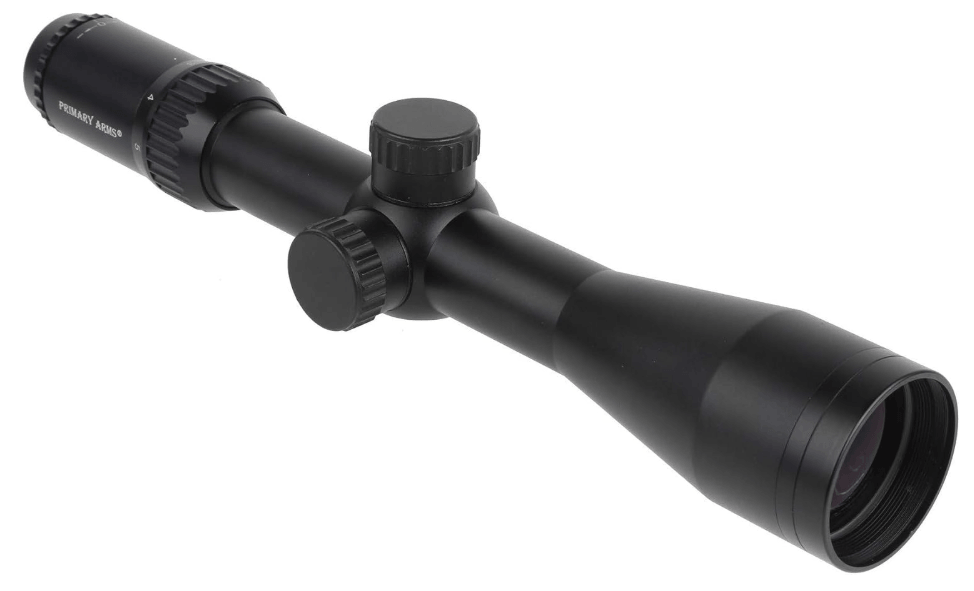
The Primary Arms Classic 3-9×44 SFP Duplex is designed around a familiar hunting-scope layout. It has a second-focal-plane duplex reticle, capped turrets, and a 44mm objective lens.
One important qualification: Primary Arms describes this specific Classic model as suited to rimfire through 5.56 NATO use. That means it should not be treated as a universal recommendation for every deer rifle or cartridge. Check the manufacturer’s stated compatibility for your intended firearm before considering it.
Why Choose It
The main attraction is its uncomplicated reticle and conventional magnification range. There are no illuminated aiming points to manage, and the second-focal-plane reticle stays the same apparent size as magnification changes.
Its 44mm objective is slightly larger than the 40mm lenses on several alternatives. That difference affects the scope’s potential exit pupil, but it does not independently prove superior low-light performance.
Key Features
Magnification: 3-9x
Objective lens: 44mm
Weight: 18.4 ounces
Reticle: Duplex
Focal plane: Second focal plane
Tube diameter: 30mm
Eye relief: 3.6 to 3.8 inches
Adjustment value: 1/4 MOA per click
Turrets: Capped, finger-adjustable
Manufacturer-listed protection: Waterproof and fog-resistant
What These Features Mean in Real Use
A duplex reticle has thicker outer posts that taper toward a finer central aiming area. This design is easy to understand and does not require the hunter to interpret a complex grid of holdover marks.
The 3-9x range suits general observation and aiming, but the scope’s 18.4-ounce weight makes it heavier than the Banner 2 and Talos models listed above. That difference matters when carrying a rifle over long distances.
The 30mm tube is also relevant when buying rings. Make sure the mounting hardware matches the scope’s actual tube diameter, not simply the objective lens size.
Trade-Offs
The main limitation is cartridge compatibility. Although the product may be attractive to budget-conscious buyers, the manufacturer’s stated application means hunters should confirm suitability for their particular deer rifle before purchasing.
It also lacks illumination and has no listed adjustable parallax on the cited product page.
May Not Be Ideal If
You use a deer rifle whose cartridge falls outside the manufacturer’s stated application, or you want a lighter scope, illumination, or a specialized holdover reticle.
Pros
Simple duplex reticle
Familiar 3-9x magnification
Capped turrets
Fully multi-coated lenses
Published eye-relief and adjustment specifications
Cons
Relatively heavy at 18.4 ounces
No illuminated reticle
Manufacturer’s stated cartridge application limits its suitability for some deer rifles
Decision Summary
Best if: Your rifle and cartridge are compatible with the manufacturer’s specifications and you want a conventional duplex scope.
Consider another option if: Your hunting rifle requires a scope rated for a different cartridge or you want a lighter setup.
4. Athlon Talos 3-12×40 Center X
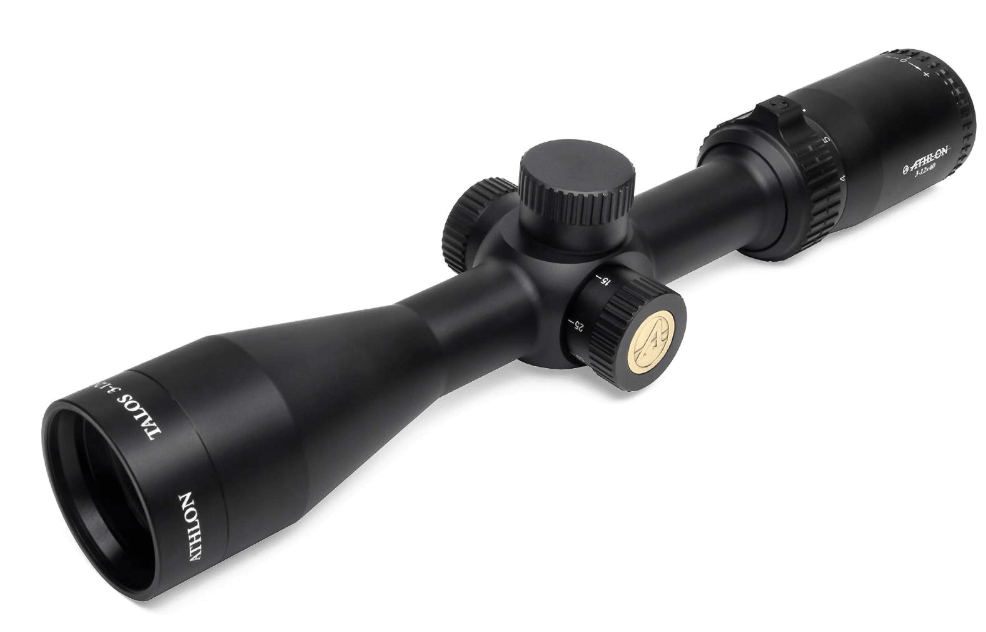
Best for a conventional reticle with extra magnification
The Athlon Talos 3-12×40 Center X shares the Talos platform’s 3-12x magnification range, 40mm objective, and 16.2-ounce weight with the illuminated BDC model. Its key difference is the Center X reticle, which gives buyers an alternative to the illuminated holdover design.
Why Choose It
This model suits hunters who want more magnification than a 3-9x scope provides but prefer a simpler reticle. The absence of a battery-powered illuminated aiming point means one less electronic feature to manage.
Athlon lists fully multi-coated optics, a 1-inch tube, capped turrets, and parallax adjustment from 15 yards.
Key Features
Magnification: 3-12x
Objective lens: 40mm
Weight: 16.2 ounces
Reticle: Center X
Focal plane: Second focal plane
Tube diameter: 1 inch
Eye relief: 3.8 to 3.35 inches
Parallax: Adjustable from 15 yards to infinity
Adjustment value: 0.25 MOA per click
Turrets: Capped
What These Features Mean in Real Use
At 3x, you can maintain a wider view of the surrounding area. At 12x, you gain more apparent target detail, although that setting can make the sight picture less forgiving when you are moving or trying to acquire a target quickly.
Its weight is reasonable for a scope with adjustable parallax, while the capped turrets help protect the settings during routine transport.
A conventional reticle also reduces the learning curve for someone who prefers to keep aiming uncomplicated. Still, you should confirm the exact reticle layout before buying because reticle names and configurations matter when comparing similar models.
Trade-Offs
The higher maximum magnification can be useful in open country, but it is not necessarily beneficial for close encounters in thick cover. The scope also lacks the illuminated aiming point found in the BDC 600 IR version.
May Not Be Ideal If
You rarely need more than 6x magnification, want the simplest possible fixed-parallax arrangement, or specifically need a calibrated BDC reticle.
Pros
3-12x magnification
Conventional Center X reticle
Adjustable parallax
Moderate weight
Capped turrets
Cons
No illuminated reticle
Higher magnification narrows the field of view
More features than some short-range hunters need
Decision Summary
Best if: You want extra magnification without choosing the illuminated BDC configuration.
Consider another option if: Your hunting is almost entirely close-range and you would prefer a simpler 3-9x optic.
5. Bushnell Banner 2 4-12×40
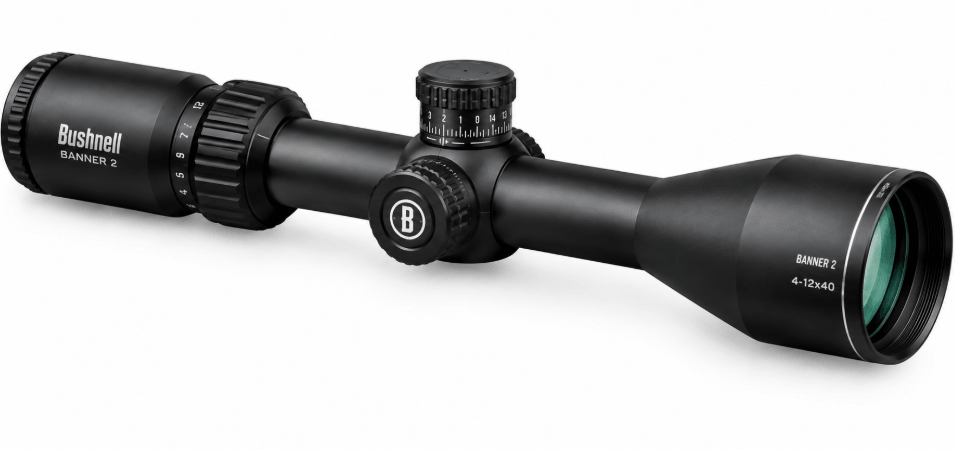
Best for hunters who prefer more magnification
The Bushnell Banner 2 4-12×40 offers a 4-12x magnification range and an adjustable objective. Compared with a 3-9×40 scope, it places more emphasis on higher magnification and distance-specific focus adjustment.
This configuration is better suited to considering open terrain than to prioritizing a wide view at very close range.
Why Choose It
Bushnell’s technical manual lists the 4-12×40 version with a QBR reticle, capped turrets, adjustable objective, and 17.8-ounce weight.
The adjustable objective gives the hunter a way to correct parallax at different distances. This is useful for fine aiming, although the feature is not essential for every ordinary hunting situation.
Key Features
Magnification: 4-12x
Objective lens: 40mm
Weight: 17.8 ounces
Reticle: QBR
Turrets: Capped
Parallax: Adjustable from 10 yards
Eye relief at maximum magnification: 3.3 inches
Length: 13.4 inches
What These Features Mean in Real Use
The 4x minimum magnification is narrower than the 3x starting point on the other models. That matters when a deer appears unexpectedly at close range or moves through thick vegetation. You have less field of view available at the lowest setting.
At the other end, 12x can help you inspect a stationary animal across open ground. However, additional magnification does not make a difficult shot safe or ethical, and it cannot compensate for poor visibility, an unstable shooting position, or inadequate target identification.
The adjustable objective is another useful distinction. It helps manage parallax at different distances, but adds a control that must be set correctly when needed.
Trade-Offs
The higher minimum magnification makes it less versatile in thick cover, and its 17.8-ounce weight is greater than that of the standard Banner 2 3-9×40. Eye relief is also shorter at maximum magnification, so mounting and eye position deserve particular attention.
May Not Be Ideal If
You hunt dense woods, frequently encounter deer at short distances, or prefer a lighter scope with a wider low-power view.
Pros
4-12x magnification
Adjustable objective
Capped turrets
QBR reticle
Useful additional magnification for open terrain
Cons
Narrower field of view at minimum power than a 3x scope
Heavier than the standard Banner 2 3-9×40
Shorter listed eye relief at maximum magnification
Decision Summary
Best if: You mainly hunt open terrain and value higher magnification and adjustable parallax.
Consider another option if: Your deer hunting involves thick timber or sudden close-range encounters.
Factors to Consider When Choosing Budget Deer Hunting Scopes
The best budget deer hunting scope is not necessarily the one with the most magnification or the largest objective lens. It is the one whose optical design, reticle, weight, and controls match the conditions in which you hunt.
1. Magnification and Field of View
For many deer hunters, a 3-9x scope is a practical starting point. Its lower setting gives you a wider field of view, while its higher setting allows closer inspection of a stationary target.
A 4-12x scope can make sense in more open terrain, but the 4x minimum is less forgiving when a deer appears close by. Higher magnification also narrows the field of view and makes movement more noticeable.
Think about the terrain you hunt most often rather than choosing a scope based on its maximum power alone.
2. Objective Lens and Low-Light Performance
The objective lens is the front lens of the scope. A larger objective can produce a larger exit pupil at the same magnification, but that does not automatically mean a clearer or brighter image.
Optical glass, lens coatings, contrast, internal light transmission, and magnification all influence the usable image. For instance, a 40mm objective at 8x produces a theoretical exit pupil of 5mm, while a 50mm objective at the same magnification produces 6.25mm.
Hunters who regularly operate during dawn and dusk should compare the complete optical system, not just lens diameter. If a more visible aiming point is important, an illuminated reticle scope for dawn and dusk is another category worth understanding; illumination can help distinguish the reticle, but it cannot restore lost image detail or make an unidentified target safe to shoot.
3. Reticle Design
A simple duplex reticle is often sufficient for conventional hunting distances. Its thicker outer posts draw the eye toward the center, and its uncomplicated layout is easy to understand.
A ballistic-drop-compensating reticle provides additional reference points for holdover. Those points only work as intended when you understand their calibration and account for the actual trajectory of your ammunition.
Illumination is a separate consideration. It can make the aiming point more visible against dark backgrounds, but it does not replace a clear sight picture or proper target identification.
4. Eye Relief and Mounting
Eye relief is the distance between your eye and the eyepiece at which you see the full image. Adequate eye relief matters for comfort, repeatable alignment, and preventing the scope from striking your brow during recoil.
Check the eye-relief specification at the magnification you are most likely to use. Some scopes provide less eye relief at maximum power.
Proper mounting is just as important as the published number. The scope should be positioned to provide a full sight picture from a natural shooting position, including when you wear hunting clothing or glasses. If you use a hard-recoiling rifle, prioritize a suitable eye-relief margin and have the setup checked by a qualified gunsmith when necessary.
5. Weight and Rifle Balance
Scope weight affects the overall balance of your rifle. A lighter optic can be more comfortable when walking long distances, while a heavier scope may add bulk that you notice during off-hand shooting.
Compare the listed scope weight rather than the weight of a package that includes rings or other accessories. Also consider the mounting hardware, because a large objective may require higher rings depending on the rifle and barrel clearance.
The difference between two scopes weighing 14.8 and 18.4 ounces is 3.6 ounces. That may not seem substantial in isolation, but the scope is only one part of the equipment you carry throughout a hunting day.
6. Turrets, Parallax, and Weather Protection
Capped turrets help protect adjustment controls against accidental movement during transport. They suit hunters who typically zero their rifles and leave the settings alone.
Adjustable parallax is useful when you need to refine focus and reduce aiming error caused by parallax at different distances. However, it adds a control that some hunters may rarely use.
Weather protection matters because hunting can involve rain, temperature changes, and damp storage. Look for manufacturer-confirmed waterproof and fog-proof construction rather than assuming every budget optic has the same protection.
Finally, check the exact rifle and mounting arrangement. A scope that works for one platform may require different rings or may not be appropriate for another. For example, hunters comparing rifles should review a scope guide for the Savage Axis deer rifle or a scope guide for the Marlin 336 lever-action rifle when either platform matches their firearm. These rifle-specific considerations can help narrow the choice before purchasing mounting hardware.
Frequently Asked Questions
1. What magnification is best for deer hunting on a budget?
A 3-9x scope is a sensible starting point for many deer hunters. The low setting offers a wider field of view in timber, while 9x provides useful magnification for carefully aiming at stationary animals at suitable distances. Hunters who spend most of their time in open terrain may prefer 3-12x or 4-12x.
2. Is a 50mm objective lens better than a 40mm lens for deer hunting?
Not automatically. A 50mm objective can provide a larger exit pupil at the same magnification, but actual image quality also depends on the glass, coatings, and optical design. A 40mm scope may be a better choice when you value a lighter, more compact setup.
3. Do I need an illuminated reticle for deer hunting?
No. A conventional duplex reticle is adequate for many daytime hunting situations. Illumination can make the aiming point easier to distinguish against dark backgrounds, particularly in changing light, but it does not guarantee better image clarity or justify shooting when you cannot identify the target clearly.
Conclusion
Choosing among the best budget deer hunting scopes comes down to matching the optic to your terrain, rifle, and typical shooting distance.
The Bushnell Banner 2 3-9×40 offers a conventional magnification range and capped turrets. The Athlon Talos 3-12×40 BDC 600 IR adds illumination and holdover references, while the Center X version provides extra magnification with a different reticle configuration. The Primary Arms Classic 3-9×44 offers a simple duplex design but requires particular attention to cartridge compatibility. The Bushnell Banner 2 4-12×40 is more appropriate for hunters who prioritize higher magnification and adjustable parallax over a wider low-power view.
Before buying, verify the exact model, reticle, cartridge suitability, and current Amazon listing. Choose the simplest scope that meets your real hunting needs, and prioritize a clear sight picture, appropriate eye relief, and reliable mounting over specifications you may never use.