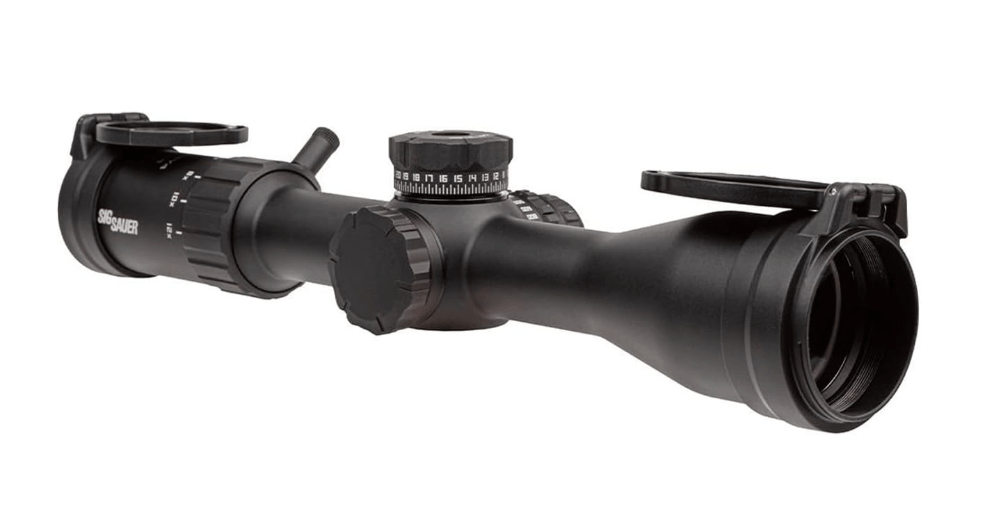
Whitetail deer are often most active around dawn and dusk, when fading natural light can make it harder to distinguish an animal from dark timber, brush, and shaded field edges. The right riflescope can help you see the target more clearly and identify a useful aiming point, provided there is enough ambient light and the conditions allow a safe, ethical shot.
When choosing a low-light scope for whitetail deer, look beyond the objective lens diameter. Optical coatings, image contrast, magnification, exit pupil, and reticle design all influence how useful a scope is as daylight fades. An illuminated reticle can make the aiming point easier to see, but it cannot brighten a dark scene or replace positive target identification.
For most deer hunters, a practical magnification range and a clear, uncluttered reticle matter more than extreme magnification. A 3–9x scope is well suited to many wooded hunting situations, while a 3–12x model offers additional flexibility for hunters who also watch open fields.
This guide compares five scopes with features relevant to low-light whitetail hunting, using published manufacturer specifications to explain their strengths and limitations.
Quick Decision Table
| Scope | Best For | Weight | Magnification | Key Advantage | Check Price |
|---|---|---|---|---|---|
| Bushnell R5 3–9×40 Illuminated Multi-X | Traditional deer hunting | 19.5 oz | 3–9x | Illuminated center dot and protective lens coating | 👉 View on Amazon |
| Athlon Talos 3–12×40 BDC 600 IR | Budget-conscious hunters | 16.2 oz | 3–12x | Illuminated reticle and side-focus adjustment | 👉 View on Amazon |
| Vortex Crossfire II 3–12×56 Hog Hunter | Larger objective lens | 27.9 oz | 3–12x | 56mm objective and illuminated V-Brite reticle | 👉 View on Amazon |
| Burris Four Xe 3–12×56 | Traditional illuminated hunting reticle | 24 oz | 3–12x | 56mm objective and illuminated German 3P #4 reticle | 👉 View on Amazon |
| SIG SAUER WHISKEY4 3–12×44 Low Profile Illuminated | Balanced objective size | Model-specific | 3–12x | Illuminated reticle with a 44mm objective | 👉 View on Amazon |
How These Products Were Chosen
The scopes were compared using the features that directly influence their suitability for whitetail deer hunting in fading daylight.
Low-light aiming: Whether the specific configuration has an illuminated reticle, and how that illumination may help the hunter distinguish the aiming point.
Optical design: Published lens-coating information and objective lens size, without assuming that a larger lens automatically produces a brighter image.
Magnification: Whether the scope offers a practical low setting for woodland hunting and enough additional magnification for open terrain.
Weight and dimensions: How the scope may affect the handling and mounting of a hunting rifle.
Adjustments and durability: Published parallax, turret, weather-resistance, and construction features where available.
1. Bushnell R5 3–9×40 Illuminated Multi-X — Best for Traditional Deer Hunting
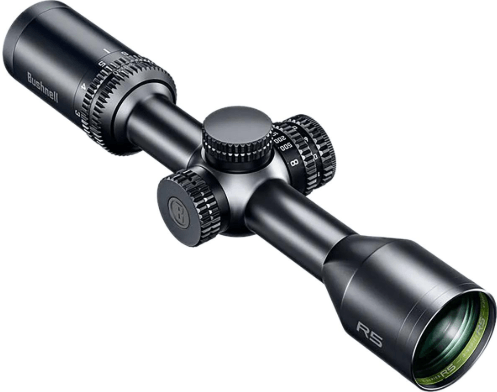
Best for: Hunters who want familiar 3–9x magnification and an illuminated aiming point without moving to a bulky 56mm scope.
The Bushnell R5 3–9×40 is a practical configuration for hunters who spend most of their time in timber, brush, or field-edge locations. Bushnell lists this model with a 40mm objective lens, a second focal plane reticle, fully multi-coated optics, and an illuminated Multi-X reticle with a floating center dot. The manufacturer also lists an IPX7 water-resistance rating and EXO Barrier lens protection.
Why Choose It
The 3–9x range suits many conventional deer-hunting situations. Lower magnification provides a wider field of view for locating a deer, while 9x gives additional aiming detail when the animal is farther away and conditions permit a careful shot.
The illuminated Multi-X version is especially relevant when a dark crosshair becomes difficult to distinguish against shaded vegetation or a dark deer. Its illuminated center dot provides a more visible aiming reference without requiring the entire reticle to glow.
Key Features
Magnification: 3–9x
Objective lens: 40mm
Reticle: Illuminated Multi-X
Focal plane: Second focal plane
Tube diameter: 1 inch
Published weight: 19.5 ounces
Fully multi-coated optics
EXO Barrier lens protection
IPX7 water-resistance rating
What These Features Mean in Real Use
A 40mm objective keeps the scope’s front end more manageable than a 56mm design. It can also make mounting easier on rifles where a very large objective bell would require higher rings.
The fully multi-coated optics are relevant because anti-reflective coatings help reduce reflections at lens surfaces. EXO Barrier is intended to protect exterior lens surfaces against water and other contaminants, which can be useful in damp hunting conditions.
However, a 40mm objective does not guarantee superior or inferior low-light performance compared with every larger scope. Glass quality, contrast, magnification, and the available ambient light all matter.
Trade-Offs
The R5’s 3–9x range is versatile, but it offers less maximum magnification than the 3–12x alternatives in this guide. Its 19.5-ounce weight is also worth considering if you are building a lightweight rifle.
May not be ideal if: You specifically want a 56mm objective or need more than 9x magnification for your usual hunting environment.
Pros
Familiar 3–9x hunting magnification
Illuminated center dot
Fully multi-coated optics
Protective EXO Barrier lens coating
Published water-resistance rating
Cons
Smaller objective than the 56mm alternatives
Heavier than some lightweight hunting scopes
Reticle versions must be distinguished carefully
Decision Summary
Best if: You want a traditional deer-hunting scope with an illuminated center dot and a manageable objective size.
Consider another option if: Your main priority is maximum exit pupil at a given magnification or a lighter overall setup.
2. Athlon Talos 3–12×40 BDC 600 IR — Best for Budget-Conscious Hunters
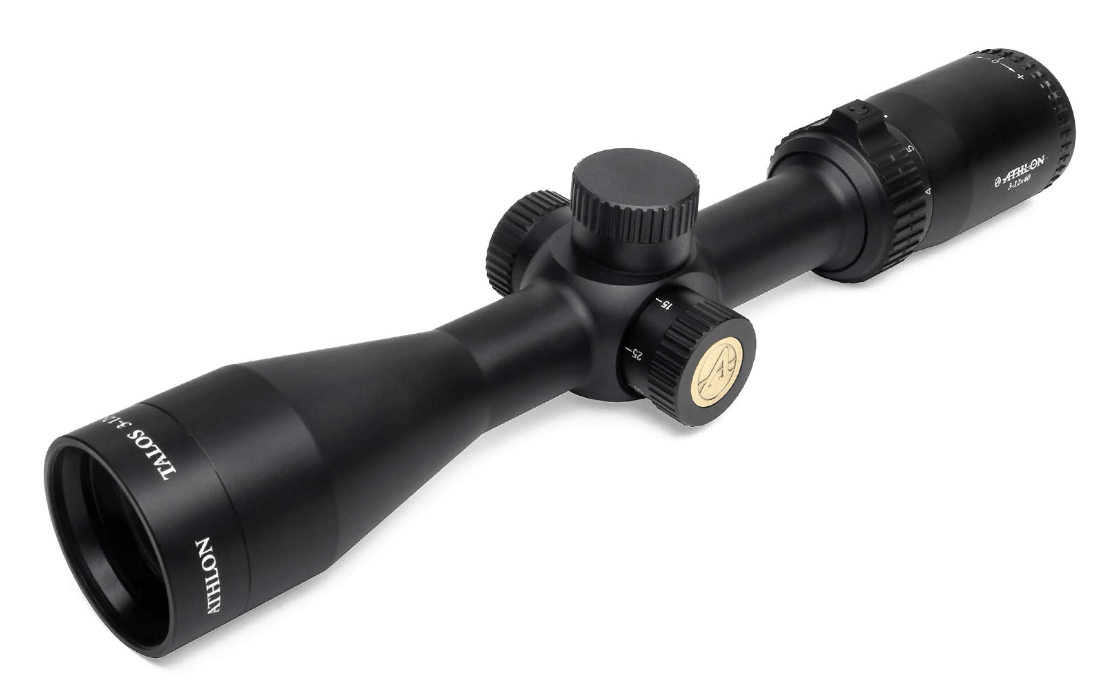
Best for: Hunters who want illuminated aiming and a 3–12x range in a relatively lightweight scope.
The Athlon Talos 3–12×40 BDC 600 IR combines a 40mm objective with a second focal plane BDC 600 illuminated reticle. Athlon lists the scope at 16.2 ounces and 12 inches long, with a 1-inch tube and side-focus parallax adjustment. Its published specifications also include fully multi-coated lenses and nitrogen-purged construction.
Why Choose It
This scope offers a useful combination of low starting magnification and extra reach at the upper end. Three power is appropriate for locating deer at relatively close distances, while 12x provides more magnification for carefully aimed shots across open ground.
The illuminated reticle may make the aiming point easier to distinguish when the dark parts of a conventional reticle blend into a shaded background. The side-focus adjustment adds flexibility for focusing the image and correcting parallax at different distances.
Key Features
Magnification: 3–12x
Objective lens: 40mm
Reticle: BDC 600 IR
Focal plane: Second focal plane
Tube diameter: 1 inch
Published weight: 16.2 ounces
Length: 12 inches
Side-focus parallax adjustment
Fully multi-coated optics
Nitrogen-purged construction
What These Features Mean in Real Use
The Talos is lighter than the Bushnell R5 and the two 56mm models listed here. That can be attractive for hunters who carry a rifle over long distances or want to keep the complete setup manageable.
Its 40mm objective offers a useful balance between size and potential exit pupil. At 8x, for example, a 40mm objective produces a theoretical exit pupil of 5mm before accounting for internal optical losses. At 12x, the theoretical exit pupil falls to approximately 3.3mm. Lower magnification can therefore be helpful when light is fading.
The BDC reticle adds aiming references, but these should not be treated as universally calibrated for every rifle and ammunition load. Confirm the reticle’s instructions and verify the rifle’s point of impact at the range.
Trade-Offs
A 40mm objective may offer a smaller theoretical exit pupil than a 56mm scope at the same magnification. The BDC reticle may also be more complicated than necessary for hunters who prefer a simple crosshair and use a confirmed zero at ordinary hunting distances.
May not be ideal if: You want a large objective lens or prefer an uncomplicated duplex-style reticle.
Pros
Relatively light at 16.2 ounces
3–12x magnification range
Illuminated BDC reticle
Side-focus parallax adjustment
Fully multi-coated optics
Cons
Smaller objective than the 56mm alternatives
BDC references require confirmation with your ammunition
Additional reticle markings may not suit every hunter
Decision Summary
Best if: You want a relatively lightweight scope with illumination, adjustable parallax, and more magnification flexibility than a basic 3–9x model.
Consider another option if: You prioritize a larger objective lens or a simpler reticle for close-to-moderate deer hunting.
3. Vortex Crossfire II 3–12×56 Hog Hunter — Best for a Large Objective Lens
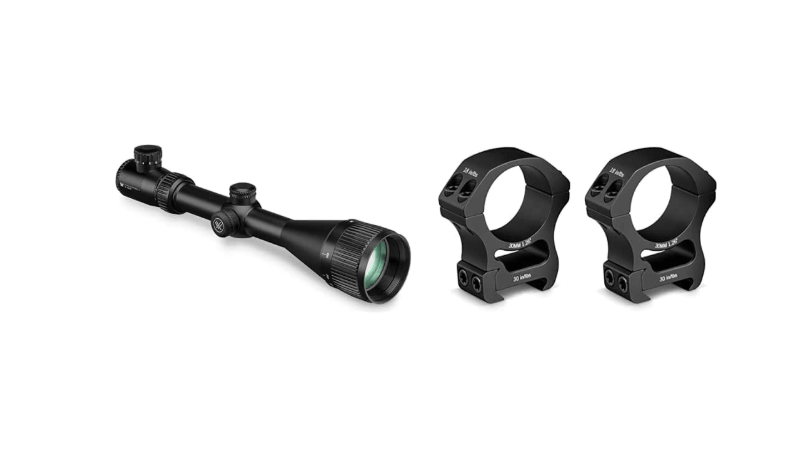
Best for: Hunters who prioritize a large objective lens and are comfortable with the added weight and mounting requirements.
The Vortex Crossfire II 3–12×56 Hog Hunter has a 56mm objective, a 30mm tube, and an illuminated V-Brite MOA reticle. Vortex describes the model as suited to low-light hunting and lists fully multi-coated optics, adjustable parallax, and waterproof, fog-proof, and shockproof construction. Its published weight is 27.9 ounces.
Why Choose It
The main attraction is the combination of a 56mm objective and an illuminated center dot. A larger objective can produce a larger exit pupil at the same magnification as a smaller objective, which can be useful when hunting in fading light.
The 3–12x magnification range also offers flexibility for hunters who move between dense cover and more open terrain. The illuminated V-Brite center dot is designed to make the aiming point easier to distinguish in low-light conditions.
Key Features
Magnification: 3–12x
Objective lens: 56mm
Tube diameter: 30mm
Reticle: V-Brite illuminated MOA
Focal plane: Second focal plane
Published weight: 27.9 ounces
Adjustable parallax
Fully multi-coated optics
Waterproof, fog-proof, and shockproof construction
What These Features Mean in Real Use
The 56mm objective has a clear theoretical advantage in exit-pupil size at a given magnification. At 8x, it produces a theoretical exit pupil of 7mm, compared with 5mm for a 40mm objective. That difference may be useful in dim conditions, although the actual image depends on the complete optical system and the observer’s eye.
The trade-off is size and weight. At 27.9 ounces, the Crossfire II is considerably heavier than the Athlon Talos. The large objective may also require higher mounting rings to clear the rifle, depending on the rifle and mounting system.
Trade-Offs
A 56mm objective is not an automatic guarantee of better low-light performance. It can add bulk, increase mounting height, and make a rifle less convenient to carry. The V-Brite reticle also depends on battery-powered illumination, so checking the battery before a hunt is sensible.
May not be ideal if: You carry your rifle over long distances or want a compact scope with minimal mounting height.
Pros
Large 56mm objective
Illuminated V-Brite center dot
3–12x magnification
Adjustable parallax
Weather-resistant construction
Cons
Heavy compared with the other scopes in this guide
Larger objective may need higher rings
A large objective alone does not guarantee a brighter image
Decision Summary
Best if: You want a large objective and illuminated aiming point for hunting in dim conditions and accept the extra weight.
Consider another option if: A lightweight rifle or compact mounting arrangement matters more than the potential exit-pupil advantage.
4. Burris Four Xe 3–12×56 — Best for a Traditional Illuminated Reticle
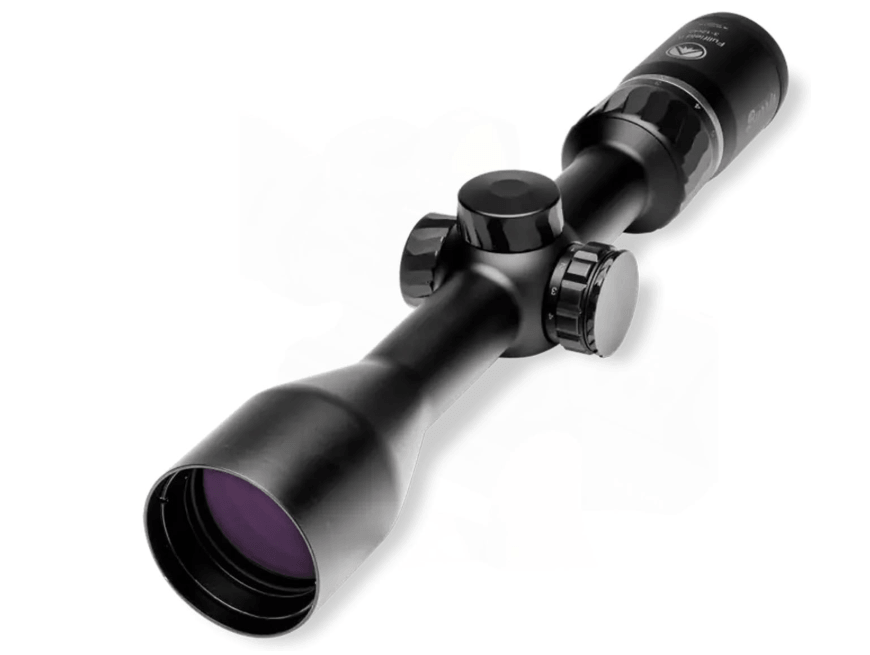
Best for: Hunters who prefer a traditional hunting reticle with a large objective lens.
The Burris Four Xe 3–12×56 combines 3–12x magnification with a 56mm objective and an illuminated German 3P #4 reticle in the manufacturer-listed item number 200504 configuration. Burris publishes a 30mm main tube, second focal plane design, 24-ounce weight, and 14.65-inch length.
Why Choose It
The Four Xe is a relevant option for hunters who want a large objective but prefer a conventional hunting reticle rather than a reticle designed primarily around ballistic holdovers.
The German 3P #4 pattern has a traditional layout with prominent outer posts and a finer central aiming area. Its illuminated center point can help the hunter find the aiming reference when dark reticle lines become difficult to distinguish against a dark background.
Key Features
Magnification: 3–12x
Objective lens: 56mm
Tube diameter: 30mm
Reticle: Illuminated German 3P #4
Focal plane: Second focal plane
Published weight: 24 ounces
Published length: 14.65 inches
Published exit pupil: 13.8mm at 3x to 5.7mm at 12x
What These Features Mean in Real Use
The 56mm objective can provide a larger theoretical exit pupil than a smaller objective at the same magnification. At 12x, Burris lists a 5.7mm exit pupil for this model, which may help deliver available light to the eye in dim conditions.
The 24-ounce weight is lower than the published weight of the Vortex Crossfire II 3–12×56 Hog Hunter, although the complete rifle setup and mounting hardware also affect handling.
The traditional reticle may appeal to hunters who want prominent outer posts and a visible illuminated center point without relying on complex holdover marks.
Trade-Offs
The 14.65-inch length and 56mm objective make this a relatively large scope. Before buying, confirm that the specific configuration is available from your intended retailer and that its mounting dimensions suit your rifle.
May not be ideal if: You need a compact scope, want the lightest possible rifle, or prefer a simple 3–9x optic for hunting primarily in thick woods.
Pros
Large 56mm objective
Illuminated German 3P #4 reticle
3–12x magnification
Published 24-ounce weight
Traditional hunting-oriented reticle pattern
Cons
Long body and large objective
More bulk than a conventional 40mm hunting scope
Reticle specifications vary across Four Xe configurations
Decision Summary
Best if: You want a large-objective scope with a traditional illuminated hunting reticle.
Consider another option if: Your priority is compact size, low weight, or a simpler setup for close-range hunting.
5. SIG SAUER WHISKEY4 3–12×44 Low Profile Illuminated — Best Middle-Ground Objective Size
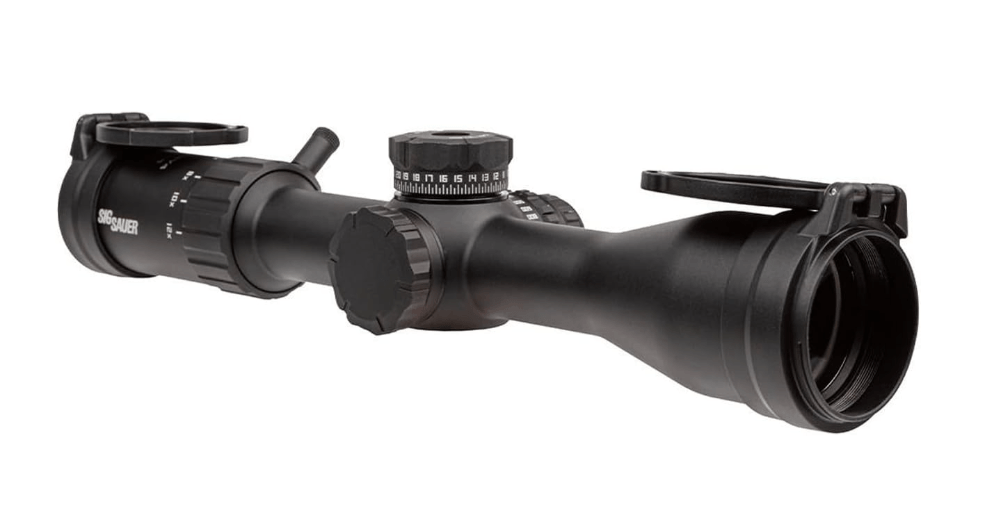
Best for: Hunters who want a 3–12x scope with an illuminated reticle and an objective size between 40mm and 56mm.
The SIG SAUER WHISKEY4 3–12×44 Low Profile Illuminated is a specific illuminated configuration in the WHISKEY4 line. SIG SAUER lists the 3–12×44 Low Profile Illuminated model separately from its non-illuminated exposed-zero-stop version, so the exact variant matters when comparing products.
Why Choose It
A 44mm objective can appeal to hunters who want more objective diameter than a typical 40mm scope without moving to the larger 56mm models. Its 3–12x magnification range also offers more flexibility at the upper end than a standard 3–9x scope.
The illuminated reticle is the key feature for low-light aiming. Its usefulness depends on the specific reticle configuration, brightness adjustment, and whether the illuminated aiming point remains easy to distinguish without overwhelming the view.
Key Features
Magnification: 3–12x
Objective lens: 44mm
Configuration: Low Profile Illuminated
Focal plane: Second focal plane, according to SIG SAUER’s WHISKEY4 product information
Illuminated reticle
Manufacturer-listed as a distinct model from the non-illuminated version
What These Features Mean in Real Use
The 44mm objective occupies a middle ground in size between the 40mm and 56mm scopes in this comparison. At 8x, a 44mm objective produces a theoretical exit pupil of 5.5mm, compared with 5mm for a 40mm objective and 7mm for a 56mm objective.
That calculation helps explain the potential difference in exit pupil, but it cannot establish which scope delivers the brightest or clearest image. Optical coatings, glass quality, contrast, internal light loss, and magnification all affect real-world viewing.
The 3–12x range is flexible for hunters who may move from wooded cover to open field edges. As with the other scopes, lower magnification may be more useful as daylight fades because it increases the theoretical exit pupil and generally provides a wider field of view.
Trade-Offs
The WHISKEY4 range includes multiple configurations, and the illuminated model should not be confused with a similarly named non-illuminated version. Before publication or purchase, confirm the current Amazon listing and exact reticle for the Low Profile Illuminated model.
May not be ideal if: You specifically want a 56mm objective for a larger theoretical exit pupil or a very lightweight scope.
Pros
44mm objective offers a middle-ground size
3–12x magnification range
Illuminated reticle configuration
Useful for varied woodland and field-edge hunting
Cons
Exact model and reticle need to match the listing
Objective is smaller than the 56mm options
Complete specifications should be checked against the precise SKU
Decision Summary
Best if: You want a 3–12x illuminated scope with an objective size between the smaller and larger options in this guide.
Consider another option if: You want a confirmed 56mm configuration or a simpler scope with fewer model variants.
Factors to Consider When Choosing a Low Light Scope for Whitetail Deer
1. Objective Lens Diameter and Exit Pupil
A larger objective lens can provide a larger exit pupil at the same magnification. Exit pupil is calculated by dividing objective diameter by magnification. For example, a 56mm objective at 8x produces a theoretical 7mm exit pupil, while a 40mm objective at 8x produces 5mm.
That does not mean the 56mm scope will always appear brighter. Optical quality, coatings, internal light loss, contrast, and the shooter’s eye all matter. A larger objective also adds bulk and may require higher mounting rings.
2. Optical Coatings and Image Contrast
Anti-reflective coatings reduce reflections at lens surfaces and can help improve light transmission. Fully multi-coated optics have multiple coatings on multiple lens surfaces. When comparing low-light scopes, consider coating information alongside magnification and objective size.
Image contrast is also important. A scope that preserves detail and separates a deer from the surrounding vegetation can be more useful than a scope that simply has a larger objective on paper.
3. Illuminated Reticle or Standard Crosshair?
An illuminated reticle can make the aiming point easier to see when dark crosshair lines blend into a shaded background. It does not brighten the whole scene or make an unidentified target safe to shoot.
Brightness control matters, too. Excessive illumination can distract from the image, so the aiming point should be adjusted to suit the ambient light. Hunters comparing reticle options can also read Optics Find’s guide to illuminated reticle scopes for dawn and dusk for a more focused comparison of illuminated models.
4. Magnification Range
For many whitetail hunters, a 3–9x scope is enough for typical woodland and field-edge distances. A 3–12x scope provides additional magnification, but higher power reduces exit pupil when objective diameter stays the same.
As light fades, try lower magnification when it provides the field of view and target detail you need. Maximum magnification is not automatically the best choice for low-light viewing.
5. Weight and Mounting Height
Scope weight affects how a rifle carries during long walks or extended sits. A 56mm objective can also require higher rings to provide adequate clearance, which may change the rifle’s cheek position and handling.
Before buying, check the scope’s tube diameter, objective-bell clearance, and compatibility with your rifle’s mounting system. Consider the combined weight of the scope, rings, and any accessories rather than looking at the optic alone.
6. Reticle and Ammunition Compatibility
A simple reticle may be sufficient if you hunt at modest distances with a confirmed zero. A BDC reticle provides additional aiming references, but those references do not automatically match every ammunition load. Bullet weight, velocity, sight height, and environmental conditions can all affect trajectory.
If you’re also comparing optics for straight-wall deer cartridges, Optics Find’s guides to scopes for .350 Legend deer hunting and scopes for .450 Bushmaster provide cartridge-specific buying context.
7. Weather Resistance and Illumination Power
Waterproof and fog-proof construction can be useful when hunting in damp weather or during temperature changes. Check the manufacturer’s stated protection rather than assuming every scope offers the same level of resistance.
For illuminated scopes, confirm the required battery type and keep a compatible spare. Check that the illumination works before a hunt, and use a brightness level that keeps the aiming point visible without obscuring the target.
Frequently Asked Questions
1. What is the best objective lens size for low-light whitetail hunting?
A 50mm or 56mm objective can provide a larger exit pupil than a 40mm objective at the same magnification. However, objective size alone does not determine image brightness. Glass quality, lens coatings, magnification, contrast, and available ambient light also matter. A 40mm scope can still be a practical choice when weight and compact size are priorities.
2. Is an illuminated reticle necessary for deer hunting at dawn and dusk?
No. A clear conventional reticle can work well if it remains visible against the target and background. An illuminated center dot can help when a dark reticle becomes difficult to distinguish in shade, but it cannot improve the visibility of the entire scene. Choose a scope whose reticle remains easy to use in the lighting conditions you actually encounter.
3. Is a 3–9x scope better than a 3–12x scope for whitetail deer?
Neither is automatically better. A 3–9x scope is often sufficient for woodland hunting and common deer-hunting distances. A 3–12x scope offers more top-end magnification for open terrain, but higher magnification reduces exit pupil and can make the view less useful in fading light. Choose based on your terrain, typical distances, and need for a wider field of view.
Conclusion
The best low-light scope for whitetail deer balances optical clarity, reticle visibility, magnification, objective size, and handling. The Bushnell R5 3–9×40 Illuminated Multi-X offers familiar hunting magnification and an illuminated center dot, while the Athlon Talos 3–12×40 BDC 600 IR combines illumination with a relatively light design and adjustable parallax. Hunters who prioritize a large objective can compare the Vortex Crossfire II and Burris Four Xe 3–12×56 models, while the SIG SAUER WHISKEY4 3–12×44 Low Profile Illuminated provides a middle-ground objective size.