Finding a high-end rifle scope under $1,000 means looking beyond magnification and brand reputation. At this price point, hunters and precision shooters can find optics with useful reticles, refined adjustment systems, quality lens coatings, and features that support more demanding shooting.
The challenge is choosing the right combination. A lightweight hunting scope needs to balance optical performance with portability, while a precision-oriented model may benefit more from a first focal plane reticle, adjustable parallax, and repeatable elevation adjustments.
This guide compares five rifle scopes or scope configurations positioned below $1,000 by their published manufacturer prices, with an emphasis on practical differences. Prices and product configurations can change, so the budget should be confirmed for the exact model before purchase.
Quick Decision Table
| Rifle scope | Best for | Weight | Magnification | Key advantage | Check Price |
| Vortex Viper HD 2–10×42 | General hunting | 19.9 oz | 2–10x | Illuminated BDC reticle | 👉 View on Amazon |
| Athlon ARES HLR 2.5–15×42 | Lightweight hunting and varmint use | 18.9 oz | 2.5–15x | Broad magnification range with adjustable parallax | 👉 View on Amazon |
| Burris Signature HD 3–15×44 | Versatile hunting | Not Specified | 3–15x | Balanced magnification range | 👉 View on Amazon |
| Burris Signature HD 5–25×50 Fine Plex | Precision-oriented target shooting | Not Specified | 5–25x | High magnification with a fine reticle | 👉 View on Amazon |
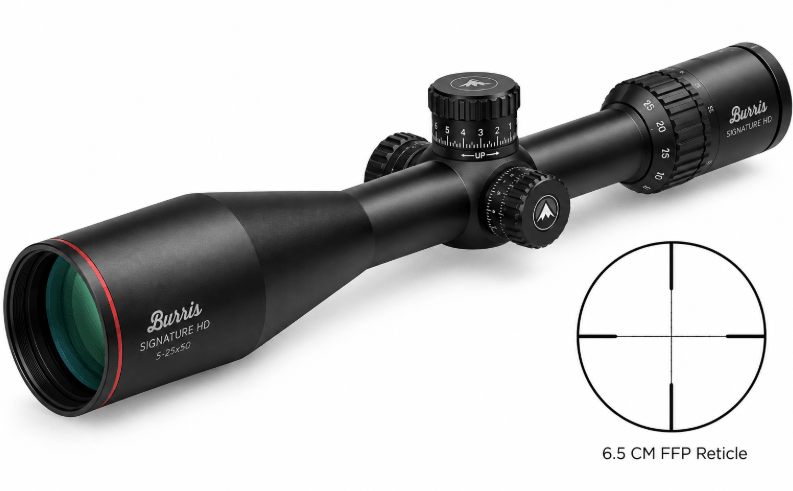
| Burris Signature HD 5–25×50 6.5 CM FFP | Long-range target shooting | Not Specified | 5–25x | First focal plane reticle | 👉 View on Amazon |
Quick Recommendations
Choose the Vortex Viper HD 2–10×42 if you want a versatile hunting scope with an illuminated reticle, a manageable weight, and a useful low-power setting.
Choose the Athlon ARES HLR 2.5–15×42 if you want a relatively light scope with more magnification flexibility and adjustable parallax.
Choose the Burris Signature HD 3–15×44 if you want a conventional hunting-oriented magnification range that can also accommodate occasional longer-range observation.
Choose the Burris Signature HD 5–25×50 Fine Plex if you prefer high magnification with a relatively uncluttered reticle for target shooting.
Choose the Burris Signature HD 5–25×50 6.5 CM FFP if you want a first focal plane reticle for more structured long-range shooting and the exact configuration suits your needs.
How These Products Were Chosen
A $1,000 budget can buy very different kinds of riflescopes. The comparisons here prioritize useful optical features, reticle design, weight, magnification, adjustment options, and suitability for the intended application.
The recommendations also distinguish between second focal plane (SFP) and first focal plane (FFP) designs. An SFP reticle stays the same apparent size as magnification changes, while an FFP reticle grows or shrinks with the image, preserving its subtensions at the reticle’s calibrated magnification settings.
Finally, the guide separates hunting-oriented scopes from models better suited to stationary target shooting. A feature that helps at the range may add unnecessary weight or complexity to a rifle carried through the field.
1. Vortex Viper HD 2–10×42 — Best for General Hunting
Best for: Hunters who want a compact, versatile scope for wooded terrain, field edges, and moderate distances.
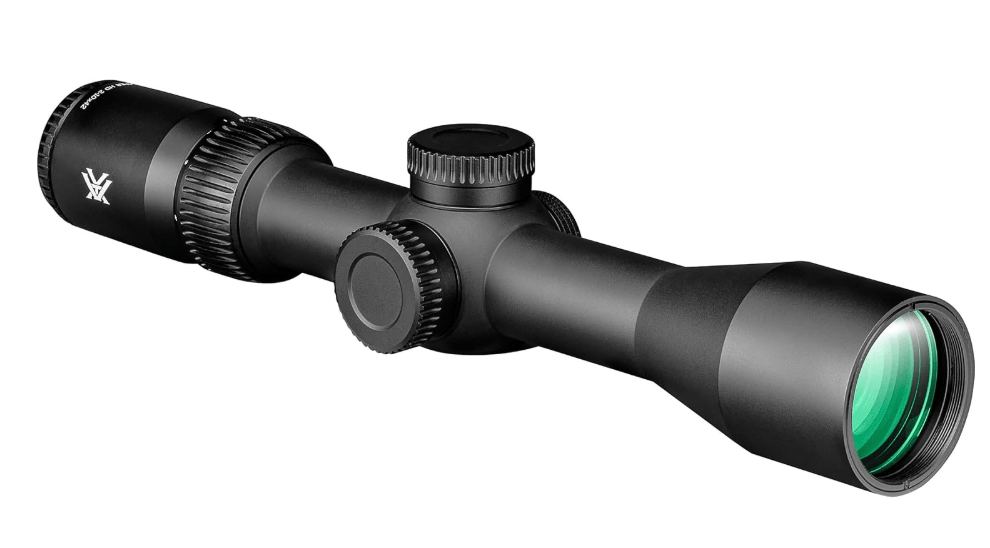
The Viper HD 2–10×42 combines a practical hunting magnification range with an illuminated Dead-Hold BDC reticle. Its 2x minimum magnification makes it easier to maintain a wider field of view at close distances, while 10x provides more detail when viewing a distant target.
At a published MSRP of $899.99, it fits the budget without requiring a sale to meet the price ceiling.
Why Choose It
The 2–10x range is especially useful for hunters who move between different environments. At lower magnification, it is easier to locate a target and maintain awareness of the surrounding scene. At higher magnification, the scope provides more detail for aiming when conditions and distance permit.
The illuminated BDC reticle adds reference marks for estimating holdover and windage. These marks can help with different shooting distances, but their practical accuracy depends on the cartridge, ammunition, zero, and the specific reticle’s calibration.
Key Features
Magnification: 2–10x
Objective lens: 42mm
Weight: 19.9 ounces
Focal plane: Second focal plane
Reticle: Illuminated Dead-Hold BDC, MOA
Tube diameter: 30mm
Eye relief: 3.4 inches
Field of view: 61.6 feet at 2x to 11.9 feet at 10x, at 100 yards
Capped turrets and 1/4-MOA adjustment increments
Waterproof, fogproof, and shockproof construction.
What These Features Mean in Real Use
The 42mm objective provides a reasonable balance between light-gathering potential and mounting size. At 10x, its theoretical exit pupil is 4.2mm; at 5x, it is 8.4mm. These calculations describe the diameter of the light beam leaving the eyepiece, not a guarantee of image brightness.
The 19.9-ounce weight is manageable for many hunting rifles, although the rings and other accessories add to the total. The capped turrets also reduce the likelihood of accidentally changing the zero while carrying the rifle.
Trade-Offs
The scope’s 10x maximum magnification is sufficient for many hunting situations, but it offers less detail at high power than a 15x or 25x model. The second focal plane reticle also means its holdover subtensions are accurate only at the magnification specified by the reticle documentation.
May not be ideal if: You primarily shoot paper targets at longer distances and need higher magnification, exposed precision turrets, or a first focal plane reticle.
Pros
Versatile 2–10x range
Illuminated BDC reticle
Manageable 19.9-ounce weight
Capped turrets for field use
Manufacturer-listed weather resistance
Cons
Less maximum magnification than precision-oriented alternatives
BDC marks require trajectory verification
Second focal plane subtensions depend on magnification
Decision Summary
Best if: You want one versatile scope for general hunting without excessive magnification or weight.
Consider another option if: Your priority is high-magnification target shooting or calibrated holdovers across the full zoom range.
2. Athlon ARES HLR 2.5–15×42 — Best for Lightweight Versatility
Best for: Hunters and varmint shooters who want a wide magnification range in a relatively light scope.
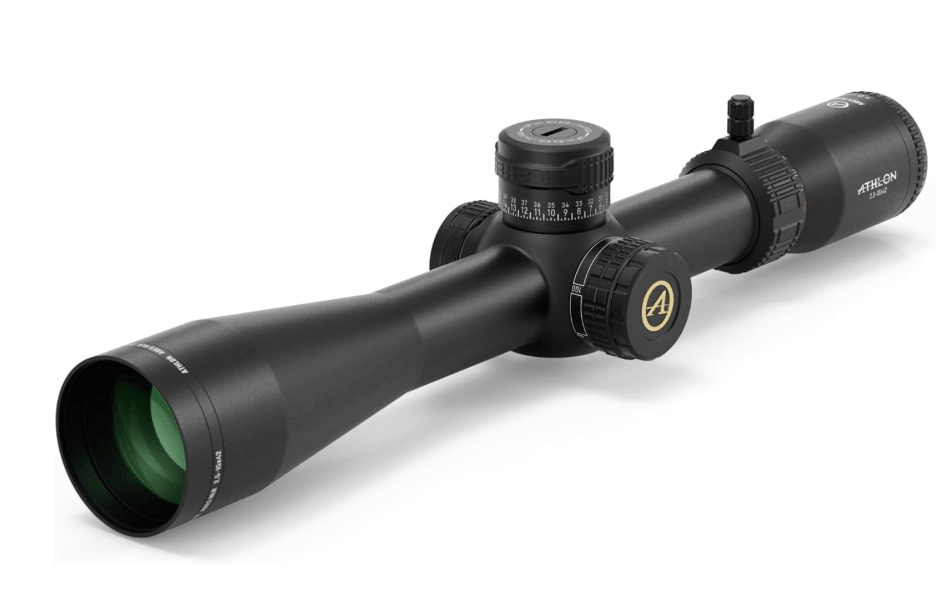
The Athlon ARES HLR 2.5–15×42 combines a 42mm objective with a 30mm tube and side-focus parallax adjustment. Athlon lists the AHMC1 Fiber Dot SFP IR MOA configuration at $962.49, with a published weight of 18.9 ounces.
Why Choose It
Its 2.5–15x range spans many common hunting needs. Lower magnification supports a wider field of view, while 15x offers more detail when evaluating a stationary target or aiming at greater distances.
The adjustable parallax is another advantage over simpler hunting scopes. It allows the shooter to adjust focus and reduce parallax error at different distances, including relatively close ranges that may matter for varmint shooting.
Key Features
Magnification: 2.5–15x
Objective lens: 42mm
Weight: 18.9 ounces
Tube diameter: 30mm
Focal plane: Second focal plane
Eye relief: 3.97 inches
Field of view: 40.9 to 6.9 feet at 100 yards
Parallax adjustment: 10 yards to infinity
Adjustment increment: 0.25 MOA for the AHMC1 configuration
Fully multi-coated optics and argon-purged, waterproof construction.
What These Features Mean in Real Use
At 18.9 ounces, the ARES HLR is slightly lighter than the Viper HD 2–10×42. That difference is modest, but weight becomes more noticeable when a rifle is carried for several hours.
The side-focus adjustment gives the shooter more control over image focus and parallax at different distances. This is useful for someone who alternates between hunting and target practice rather than using the scope exclusively at typical deer-hunting distances.
However, 15x magnification does not automatically produce better results than 10x. Higher power narrows the field of view and reduces exit pupil. Heat shimmer, mirage, and movement can also make the image less useful at high magnification.
Trade-Offs
The ARES HLR is more feature-rich than a basic hunting scope, but its exposed turrets and additional adjustment options may be unnecessary for hunters who rarely change their zero or dial elevation.
The exact reticle matters, too. Athlon offers MOA and MIL options alongside the fiber-dot version. Select the reticle that matches the adjustment system and shooting method you intend to use.
May not be ideal if: You want the simplest possible hunting setup or prefer capped turrets and a basic duplex reticle.
Pros
Wide 2.5–15x magnification range
Published weight of 18.9 ounces
Adjustable parallax from 10 yards to infinity
Fully multi-coated optics
Multiple reticle options
Cons
More adjustments than some hunters need
Second focal plane reticle
Higher magnification reduces field of view and exit pupil
Decision Summary
Best if: You want a lightweight, versatile optic that can move between hunting and varmint applications.
Consider another option if: You prefer a simple, capped-turret scope or need a first focal plane reticle.
3. Burris Signature HD 3–15×44 — Best for Versatile Hunting
Best for: Hunters who want useful mid-to-high magnification without moving to a larger 50mm objective and a heavier precision-style setup.
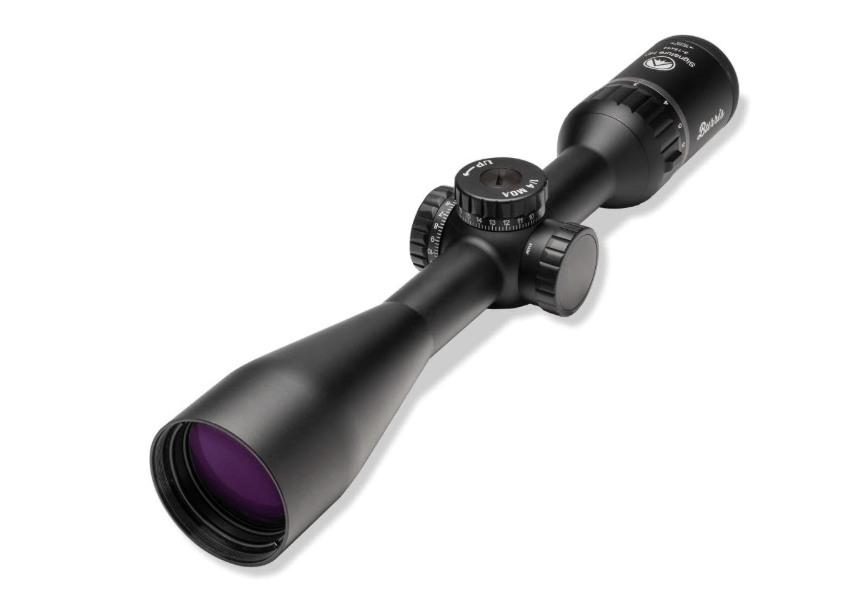
The Burris Signature HD 3–15×44 offers a flexible range for hunters who move between wooded areas and open terrain. Burris lists this model in both Ballistic Plex E1 and Fine Plex configurations, with published MSRPs of $672 and $624 respectively. These are distinct reticle options, so the exact version matters when purchasing.
Why Choose It
The 3–15x range gives you more magnification than a traditional 3–9x hunting scope while retaining a useful lower setting. It suits a hunter who wants one optic for ordinary deer hunting, occasional longer-range observation, and range practice.
The Fine Plex version favors a relatively uncluttered aiming picture. The Ballistic Plex E1 version provides additional aiming references for shooters who prefer holdovers rather than adjusting elevation for every change in distance.
If you are choosing a scope for a specific hunting rifle, the intended cartridge and typical shooting distance should guide that decision. For example, our guide to scopes for a .30-06 rifle explores how hunting distances, magnification, and portability affect the choice.
Key Features
Magnification: 3–15x
Objective lens: 44mm
Reticle choices: Ballistic Plex E1 or Fine Plex
Tube diameter, weight, eye relief, and adjustment specifications: confirm against the exact configuration before purchasing
Published MSRP: $624 for Fine Plex and $672 for Ballistic Plex E1.
What These Features Mean in Real Use
A 44mm objective sits between the 42mm objectives in the first two recommendations and the larger objectives common on precision scopes. It offers a practical compromise between mounting size and theoretical exit pupil.
The 3x low end is suitable for many ordinary hunting situations, although it does not provide the same wide field of view as a 1x or 2x setting. At 15x, the additional detail can be useful for careful aiming, but the narrower view makes it less convenient for rapidly locating a moving animal.
The choice between the two reticles depends on how you prefer to account for bullet drop. A simple reticle is often sufficient for hunters who use a confirmed zero and keep their shots within a known distance. A ballistic reticle can offer more flexibility, provided its aiming marks are verified against the actual ammunition and trajectory.
Trade-Offs
The Signature HD’s practical appeal is its balance of magnification and hunting-oriented design. However, buyers should not assume every configuration has identical specifications or adjustment features. The Fine Plex and Ballistic Plex E1 versions should be treated as separate configurations when comparing listings.
May not be ideal if: You want a first focal plane reticle, extensive precision-turret features, or very high magnification for dedicated long-range target shooting.
Pros
Versatile 3–15x magnification range
Choice of relatively simple or ballistic reticles
44mm objective balances size and magnification
Published MSRP comfortably below $1,000
Cons
Exact configuration determines reticle and specifications
Lower magnification is not as wide as a 1–2x starting point
Not the most specialized choice for long-range precision work
Decision Summary
Best if: You want a flexible hunting scope that can handle varied terrain and occasional range use.
Consider another option if: You prioritize a first focal plane reticle or a dedicated precision-shooting setup.
4. Burris Signature HD 5–25×50 Fine Plex — Best for High-Magnification Target Shooting
Best for: Target shooters who want high magnification and prefer a fine, relatively uncluttered reticle.
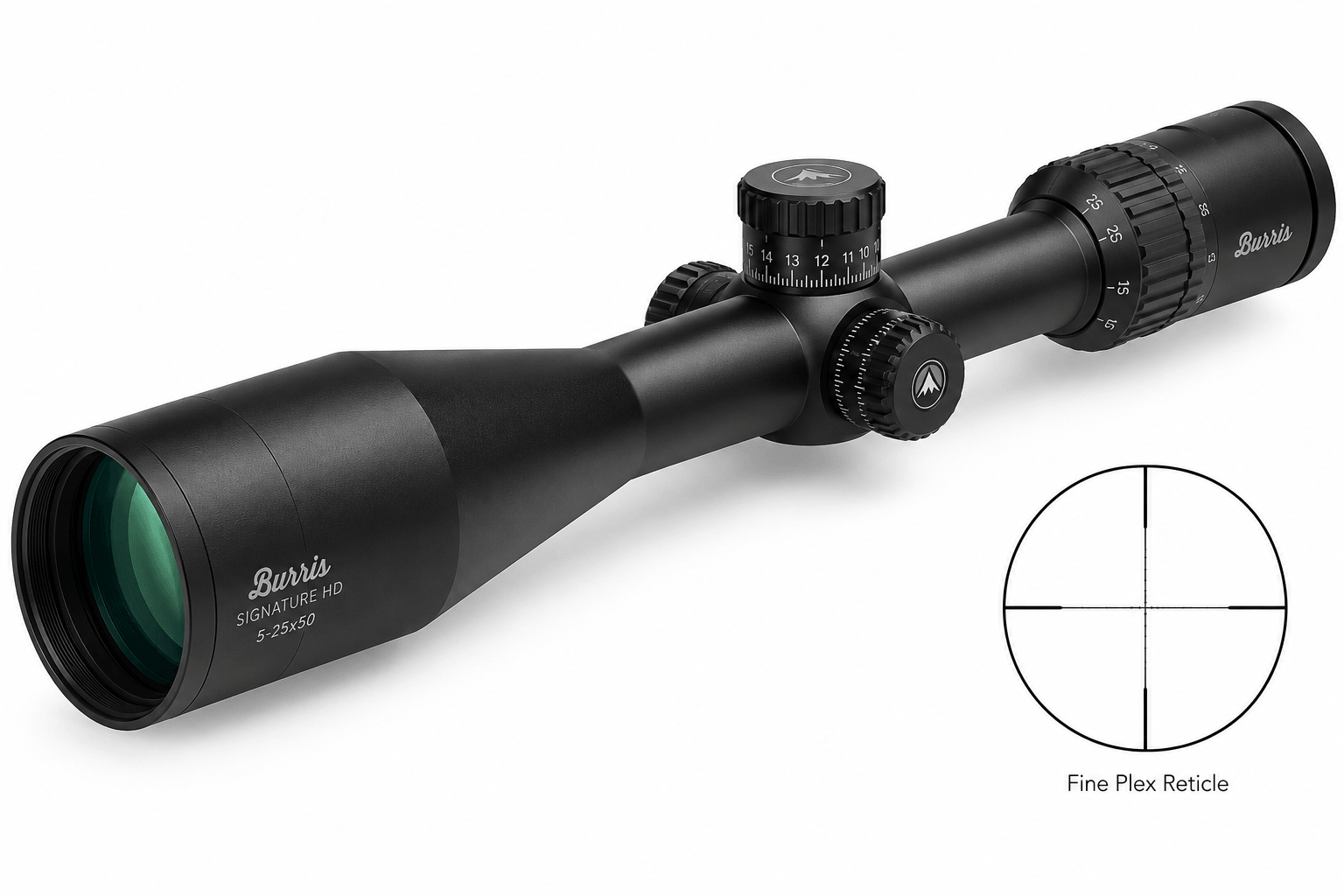
The Burris Signature HD 5–25×50 is available in several configurations, including a Fine Plex version with a published MSRP of $816. Its 5–25x magnification range is more specialized than the 3–15x scopes above, favoring stationary targets and deliberate shooting rather than general-purpose hunting.
Why Choose It
At 25x, small target details occupy more of the sight picture than they would at 10x or 15x. This can make the scope useful for evaluating aim and placing shots on paper at the range.
The Fine Plex reticle appeals to shooters who want to see the target without numerous holdover markings competing for attention. That simplicity can be helpful when dialing elevation or using a known zero, although it provides fewer built-in references than a dedicated precision reticle.
Key Features
Magnification: 5–25x
Objective lens: 50mm
Reticle: Fine Plex
Published MSRP: $816
Weight, focal plane, eye relief, turret configuration, and adjustment range: verify for the exact model.
What These Features Mean in Real Use
The 5x starting magnification is an important limitation to consider. It may feel restrictive when locating a target at close range or scanning a broad area, but it is less problematic on a rifle used mainly from a supported position at a shooting range.
The 50mm objective provides a theoretical exit pupil of 10mm at 5x and 2mm at 25x. Actual image quality depends on the full optical system, and a larger objective does not automatically guarantee superior clarity.
High magnification also makes small movements more visible. A stable rest and consistent shooting position become more important as power increases. If you mainly hunt on foot, a lighter scope with a lower starting magnification may be a more practical choice.
Trade-Offs
The Fine Plex version prioritizes a simple sight picture rather than an elaborate grid for holding windage and elevation. That can work well for target shooters who prefer a straightforward reticle, but it may be less convenient for shooters who routinely use reticle-based corrections.
Its 5x minimum magnification also makes it less versatile than the 2–10x and 2.5–15x options.
May not be ideal if: You want one scope for both close-range hunting and distant target shooting, or you need an FFP reticle for consistent subtensions across magnification settings.
Pros
High 25x maximum magnification
Fine Plex reticle for a relatively uncluttered view
50mm objective
Published MSRP below $1,000
Cons
5x minimum magnification limits versatility
High power makes movement and mirage more noticeable
Fine Plex provides fewer built-in holdover references than a grid reticle
Decision Summary
Best if: You primarily shoot stationary targets and want high magnification with a simple reticle.
Consider another option if: You need a wider field of view, a lower minimum magnification, or more advanced reticle-based corrections.
5. Burris Signature HD 5–25×50 6.5 CM FFP — Best for Precision-Oriented Shooting
Best for: Shooters who want high magnification and a first focal plane reticle for structured target practice.
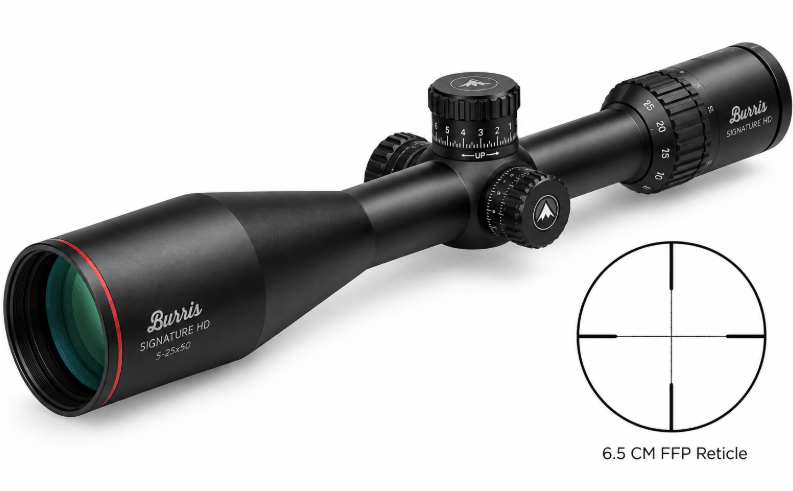
The Burris Signature HD 5–25×50 is also offered in a 6.5 CM FFP configuration, listed at $948 MSRP. The FFP designation distinguishes this version from the Fine Plex option: the reticle changes apparent size with magnification, allowing its subtensions to remain consistent as power changes.
Why Choose It
This configuration is worth considering for shooters who want to use reticle markings for holdovers and wind corrections at different magnifications. The first focal plane design makes that possible without having to return to one specific magnification to preserve the reticle’s subtensions.
The 5–25x range is suited to deliberate target shooting. It gives the shooter substantial magnification for observing target details and evaluating shot placement, provided the conditions and stability of the shooting position support it.
The 6.5 CM designation should be checked carefully against the actual model listing and reticle documentation. Do not assume the reticle is automatically calibrated for every rifle or ammunition load merely because the product name references a cartridge.
Key Features
Magnification: 5–25x
Objective lens: 50mm
Configuration: 6.5 CM FFP
Published MSRP: $948
Exact reticle, weight, adjustment increments, turret design, and adjustment range: verify for the selected SKU.
What These Features Mean in Real Use
The primary advantage of an FFP reticle is its consistent relationship to the target. At lower magnification, the reticle appears smaller; at higher magnification, it appears larger. Its measurement marks retain their intended angular values across the magnification range.
That can simplify holdover and windage corrections during target shooting. However, the shooter still needs to understand the reticle’s units, confirm the rifle’s zero, and validate the ammunition’s trajectory.
The 5–25x range also makes this a more specialized optic than the hunting-oriented options. At the upper end, even a small movement can cause the target to shift noticeably in the sight picture. A stable shooting position and appropriate support help make the added magnification useful.
Trade-Offs
The FFP design is valuable when you use the reticle’s markings, but it may be unnecessary for someone who mainly hunts with a simple crosshair. A grid can also look more prominent at lower magnification than a traditional hunting reticle.
At $948 MSRP, the listed configuration leaves little room in a strict $1,000 budget for rings, mounting equipment, or other accessories. The complete setup should be considered before purchase.
May not be ideal if: You want a lightweight hunting rifle, a simple crosshair, or a scope primarily for close-to-moderate distances.
Pros
High 5–25x magnification range
First focal plane reticle
Reticle subtensions remain consistent across magnification settings
Published MSRP below $1,000
Cons
More specialized than a general hunting scope
Near the budget ceiling before mounting accessories
Exact reticle and adjustment specifications require configuration-level confirmation
Decision Summary
Best if: You regularly use reticle markings for deliberate target shooting and want them to retain their subtensions throughout the zoom range.
Consider another option if: You prioritize portability, a simple hunting reticle, or a lower total equipment cost.
Factors to Consider When Choosing a High-End Rifle Scope
1. Magnification and Field of View
Magnification should match how you use the rifle, not simply how much detail the scope can provide at its highest setting.
2–10x: Useful for general hunting and varied terrain.
2.5–15x or 3–15x: A versatile middle ground for hunting and occasional target shooting.
5–25x: Better suited to deliberate target shooting than fast-moving field situations.
Higher magnification narrows the field of view and makes movement more noticeable. For many hunters, a scope that is easy to use at its lowest setting is more valuable than one that reaches 25x.
2. Optical Quality and Objective Diameter
A 40–44mm objective can offer a useful balance of mounting height, weight, and optical performance. A 50mm objective can produce a larger exit pupil at the same magnification, but that does not guarantee a brighter or sharper image.
Lens coatings, optical design, contrast, and available light also affect what you see. If hunting at dawn or dusk is a priority, compare the whole optical system rather than selecting a scope based on objective diameter alone. Our guide to illuminated reticle scopes for dawn and dusk explains why reticle visibility and image brightness are different considerations.
3. Reticle Design and Focal Plane
A simple Duplex or Fine Plex reticle suits shooters who prefer an uncluttered aiming point. A ballistic reticle adds reference marks for holdover, while an MOA or MIL grid can support more systematic distance and wind corrections.
An SFP reticle maintains its apparent size as magnification changes. Its subtensions must be used at the magnification specified by the manufacturer. An FFP reticle changes apparent size with magnification, preserving its subtensions throughout the zoom range.
Choose FFP if you regularly use the reticle’s measurement references at different magnifications. Otherwise, SFP may be entirely adequate for hunting and general range use.
4. Turrets and Parallax Adjustment
Capped turrets are practical for hunters who want to protect their zero during transport and movement. Exposed turrets are useful when you routinely dial elevation or windage for deliberate shooting.
Adjustable parallax helps reduce apparent reticle movement relative to the target when your eye position changes. It is particularly useful for precision shooting at different distances. For conventional hunting, a fixed parallax setting may be sufficient.
Do not assume every high-end scope needs exposed turrets or adjustable parallax. The best feature is the one that supports your actual shooting method.
5. Weight, Eye Relief, and Mounting
A scope’s weight affects rifle balance, carrying comfort, and handling. A heavier 5–25x scope can make sense on a rifle used primarily from a bench, while a lighter 2–15x optic may be more comfortable for a hunter walking long distances.
Eye relief matters for comfortable, repeatable positioning and safe clearance under recoil. Check the manufacturer’s figures at both ends of the magnification range, particularly for a rifle with substantial recoil.
Before purchasing, also confirm tube diameter, objective clearance, mounting-ring compatibility, and the position needed for a consistent cheek weld.
For cartridge-specific comparisons, the scopes for .308 Winchester bolt-action rifles guide provides additional context on balancing magnification, weight, and intended use.
6. Budget Beyond the Scope
A $1,000 scope budget does not necessarily mean spending the entire amount on the optic itself. Rings, bases, and professional mounting can add to the final cost.
A scope priced at $948 leaves less room for those items than one priced at $624. Also check the current price for the exact reticle and configuration rather than assuming that a price for one version applies to every model in the same product family.
Frequently Asked Questions
1. Can you get a high-end rifle scope for under $1,000?
Yes. Options in this price range include scopes with broad magnification ranges, illuminated reticles, adjustable parallax, and precision-oriented reticle designs. The most suitable choice depends on whether you prioritize hunting portability, optical performance, or target-shooting adjustments.
2. Is a first focal plane scope better than a second focal plane scope?
Neither is universally better. FFP is useful when you need reticle subtensions to remain consistent across magnification settings. SFP is often suitable for conventional hunting and simpler aiming methods, particularly when you understand the magnification at which the reticle references are calibrated.
3. Should I spend the full $1,000 on a rifle scope?
Not necessarily. A less expensive scope that fits your needs may leave room for suitable mounting equipment without sacrificing the features that matter most. Prioritize the correct magnification, reticle, eye relief, and adjustment system before paying for additional features you may rarely use.
Conclusion
The best high-end rifle scope under $1,000 depends on how you use your rifle. The Vortex Viper HD 2–10×42 is a versatile hunting option, while the Athlon ARES HLR 2.5–15×42 provides a broader magnification range in a relatively light package. The Burris Signature HD 3–15×44 offers a balanced hunting configuration, and its 5–25×50 versions are more appropriate for shooters who prioritize higher magnification and, in the FFP configuration, consistent reticle subtensions.
Before deciding, compare the exact configuration, verify its current price, and consider the complete mounted setup. Spending more is worthwhile only when the additional features serve a clear purpose.