
Finding the best budget thermal scopes for hog hunting means balancing thermal image clarity, a wide enough field of view, dependable battery life, and a price that fits your hunting setup. A lower-cost thermal scope can help you detect hogs after dark, but not every model provides enough detail to distinguish animals reliably at longer distances.
For hunters comparing entry-level thermal optics, the key is to choose a scope that matches the terrain and realistic shooting distances rather than paying for features you may rarely use. The five options below focus on more affordable dedicated thermal riflescopes, with particular attention to sensor resolution, magnification, weight, and practical limitations.
Quick Decision Table
| Product | Best For | Weight | Magnification | Key Advantage | Check Price |
| AGM Rattler V2 19-256 | Close-range scanning | 1.06 lb | 2.5× base | Wide field of view | 👉 View on Amazon |
| AGM Rattler V2 25-256 | General entry-level use | 1.08 lb | 3.5× base | Longer detection specification | 👉 View on Amazon |
| ATN ThOR LTV 160 3-9× | Buyers prioritizing simplicity | 1.4 lb | 3–9× | Long eye relief | 👉 View on Amazon |
| Sightmark Wraith Mini Thermal 2-16×35 | Feature-rich compact design | 19.3 oz | 2× optical base | 384×288 sensor | 👉 View on Amazon |
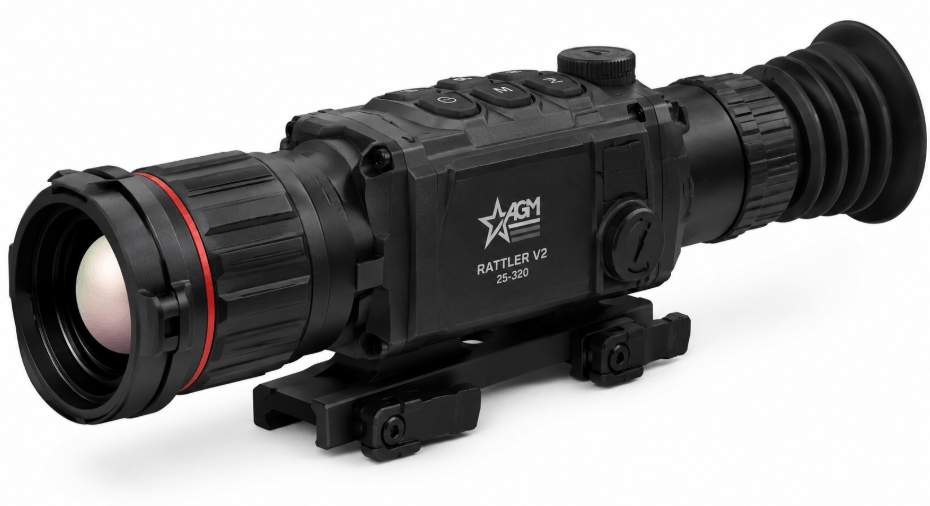
| AGM Rattler V2 25-320 | Better sensor resolution on a budget | Not Specified | 3.5× base | 320×256 sensor | 👉 View on Amazon |
Quick Recommendations
Choose the AGM Rattler V2 19-256 if: you want an entry-level thermal scope with a wide field of view for scanning nearby fields and woodland edges.
Choose the AGM Rattler V2 25-256 if: you prefer higher base magnification and a narrower view for watching more distant areas.
Choose the ATN ThOR LTV 160 if: straightforward thermal viewing and generous eye relief are more important than high sensor resolution.
Choose the Sightmark Wraith Mini Thermal if: you want a higher-resolution sensor and useful recording features in a compact body.
Choose the AGM Rattler V2 25-320 if: you want to move beyond 256×192 resolution without stepping into a premium 640-class scope.
How These Products Were Chosen
The selection emphasizes dedicated thermal riflescopes at the more accessible end of the market. The main considerations are sensor resolution, base magnification, field of view, battery endurance, weight, and useful features such as multiple reticles and onboard recording.
A thermal scope detects differences in infrared radiation rather than relying on visible light. This makes it useful for locating warm animals at night, but detecting a heat signature is not the same as identifying an animal clearly enough to make a responsible decision.
The comparison also distinguishes manufacturer-stated detection range from practical identification capability. For example, a manufacturer may quote a detection range using a standardized target, but that figure does not guarantee that a hunter can identify a hog at the same distance. For a broader comparison of premium and entry-level choices, the best thermal scope for hog hunting guide provides additional context.
1. AGM Rattler V2 19-256
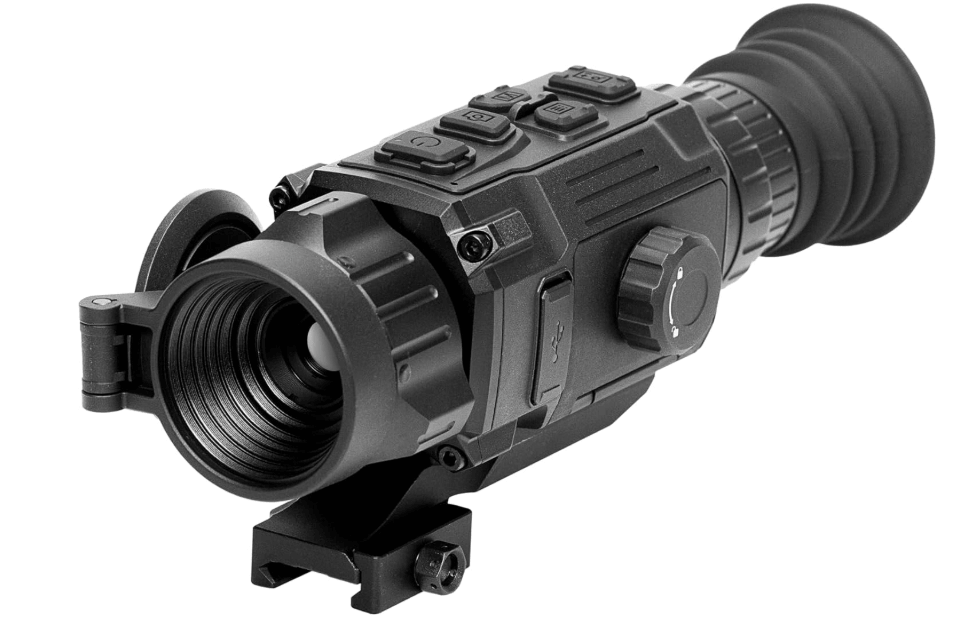
Best for close-range scanning and first-time thermal buyers
Best For
The Rattler V2 19-256 suits hunters who primarily watch nearby fields, food plots, and woodland edges. Its low base magnification and wide field of view make it a sensible starting point when hogs may appear from different directions.
Why Choose It
This is the entry-level model in AGM’s Rattler V2 lineup. Its 256×192 sensor does not provide the image detail of a higher-resolution unit, but the wide viewing angle is useful for scanning without constantly moving the rifle.
AGM lists the model with a 19mm lens, a 50Hz refresh rate, replaceable rechargeable batteries, and onboard recording. These features offer a useful mix for buyers who want a dedicated thermal optic without immediately paying for a more advanced sensor.
Key Features
Thermal sensor resolution: 256×192
Lens: 19mm, F/1.0
Base magnification: 2.5×
Digital magnification range: 2.5×–20×
Field of view: 9.3° × 6.9°
Manufacturer-stated detection range: up to 950 yards
Weight: 1.06 lb
Refresh rate: 50Hz
Battery life: up to 11.5 hours under manufacturer-stated conditions
Protection rating: IP67
What These Features Mean in Real Use
The 9.3° × 6.9° field of view is a major advantage when sweeping a field or checking a hedgerow. You can monitor more of the scene at once instead of repeatedly moving the scope to locate a heat signature.
However, the 256×192 sensor limits fine image detail compared with 320×256 or 384×288 models. Digital zoom enlarges the displayed image, but it does not create additional sensor detail. Therefore, this model is most appealing when your priority is locating animals at relatively close distances rather than identifying them at extended range.
Its listed weight of 1.06 pounds is also useful when considering rifle balance. Remember to account for the mount and any accessories when estimating the finished rifle’s weight.
Trade-Offs
The principal compromise is image resolution. The wide field of view is useful for scanning, but the lower-resolution sensor may make animal identification more difficult at longer distances or in challenging thermal conditions.
May Not Be Ideal If
You regularly observe animals across large open fields or need more image detail for identification at greater distances. A higher-resolution sensor may be a better fit.
Pros
Wide field of view
Lightweight scope body
Replaceable rechargeable battery system
Onboard recording and multiple thermal palettes
Cons
Lower resolution than the 320×256 and 384×288 alternatives
Digital zoom cannot restore missing detail
Detection-range claims should not be treated as identification distances
Decision Summary
Best if: you need an entry-level thermal scope for scanning nearby terrain.
Consider another option if: your priority is detailed viewing at longer distances.
2. AGM Rattler V2 25-256
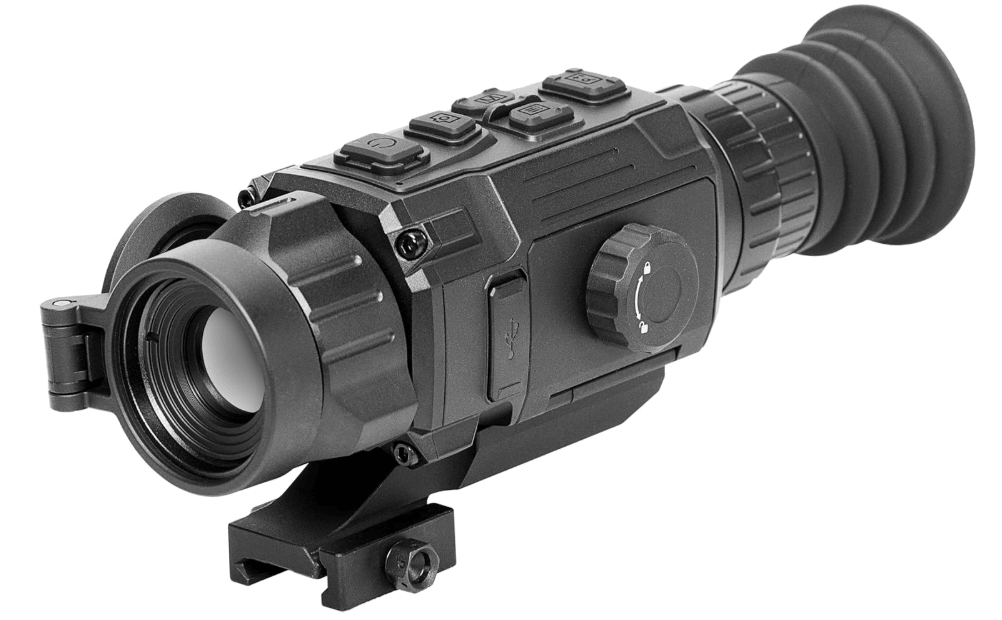
Best for buyers who want higher base magnification
Best For
The Rattler V2 25-256 is suited to hunters who want a little more base magnification for watching field margins, clearings, and other areas where animals may appear farther away.
Why Choose It
Compared with the 19-256, this model uses a 25mm lens and starts at 3.5× magnification. Its narrower field of view trades some scanning coverage for a more magnified initial image.
AGM lists the 25-256 with the same 256×192 thermal resolution as the 19-256, so the key difference is not sensor detail but the optical configuration and resulting viewing experience.
Key Features
Thermal resolution: 256×192
Lens: 25mm, F/1.0
Base magnification: 3.5×
Digital magnification range: 3.5×–28×
Field of view: 7.0° × 5.3°
Manufacturer-stated detection range: up to 1,250 yards
Weight: 1.08 lb
Refresh rate: 50Hz
Battery life: up to 11.5 hours under manufacturer-stated conditions
Protection rating: IP67
What These Features Mean in Real Use
The 25mm lens and 3.5× base magnification give the scope a tighter view than the 19-256. This can be helpful when observing a more defined area, but it also means you see less of the surrounding terrain at once.
That trade-off matters when several hogs are moving across a field or when animals enter from the side. A wider field of view can make it easier to keep track of movement, while a narrower view can make the initial image appear more magnified.
Although AGM quotes a detection range of up to 1,250 yards, that figure should not be interpreted as a guaranteed distance for identifying a hog. The 256×192 sensor remains the limiting factor when you need finer detail.
Trade-Offs
The 25-256 offers more base magnification and a longer stated detection range than the 19-256, but it sacrifices some field of view without improving sensor resolution.
May Not Be Ideal If
You hunt in dense vegetation or need to scan a wide area quickly. The 19-256’s wider field of view may be more convenient.
Pros
Higher base magnification than the 19-256
Compact design weighing 1.08 pounds
Replaceable rechargeable batteries
Multiple reticles and onboard recording
Cons
Narrower field of view
Same sensor resolution as the 19-256
Digital zoom does not increase native thermal detail
Decision Summary
Best if: you prefer a more magnified starting view for watching defined areas.
Consider another option if: broad scanning coverage matters more than base magnification.
3. ATN ThOR LTV 160 3–9×
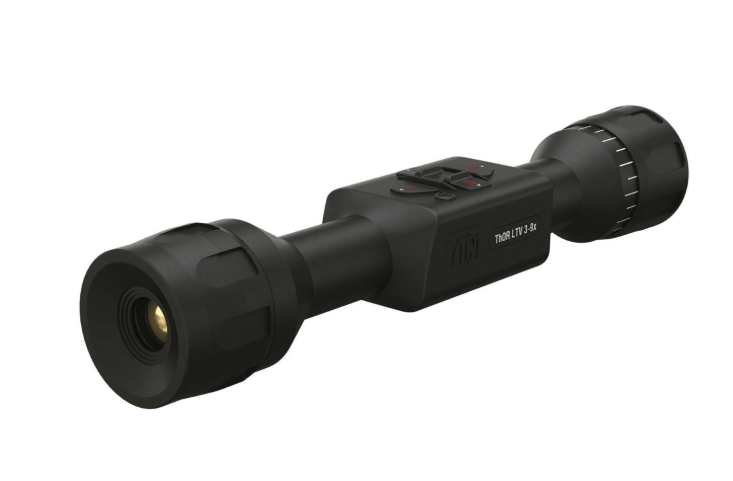
Best for buyers who prioritize straightforward operation
Best For
The ATN ThOR LTV 160 is an option for buyers who want a traditional-looking thermal riflescope with variable digital magnification. It may suit hunters who value a familiar scope-style layout and generous eye relief.
Why Choose It
The ThOR LTV family offers different sensor resolutions and magnification configurations. The specific 160-resolution, 3–9× model is the entry-level configuration considered here; specifications from the higher-resolution LTV versions should not be applied to it.
ATN’s published catalog lists the 160 model with a 160×120 sensor, 3–9× magnification, and approximately 90mm of eye relief. That eye relief provides a generous viewing distance between your eye and the eyepiece, although comfortable alignment still depends on your shooting position and mounting setup.
Key Features
Thermal sensor resolution: 160×120
Magnification: 3–9×
Eye relief: approximately 90mm
Display resolution: 1280×720, according to the manufacturer’s catalog
Multiple reticle patterns and thermal color modes
Internal rechargeable battery
Manufacturer-listed battery runtime: 9+ hours
Weather-resistant construction
What These Features Mean in Real Use
The biggest consideration is the 160×120 sensor. It can display thermal differences, but it provides substantially fewer image pixels than the AGM 256×192 models or the Sightmark’s 384×288 sensor. That limits the fine detail available for distinguishing an animal from surrounding objects as distance increases.
The 3–9× magnification range may look attractive on paper. However, magnification and thermal resolution are different things: increasing the digital zoom makes the image larger without recovering information the sensor never captured. For that reason, the ThOR LTV 160 is best considered for relatively close observation rather than situations that demand detailed long-distance identification.
Its generous eye relief may make positioning more comfortable for some users, but it does not remove the need to verify the scope’s mounting compatibility and recoil rating for the intended firearm.
Trade-Offs
The attraction is its familiar scope-style layout and generous eye relief. The compromise is the relatively low sensor resolution, which is the main reason to compare it carefully against other entry-level thermal models.
May Not Be Ideal If
You want to distinguish fine image details at longer distances or regularly hunt in conditions that make thermal contrast difficult to interpret.
Pros
Generous listed eye relief
Variable magnification
Multiple reticle and display options
Internal rechargeable battery
Cons
Lower sensor resolution than the other models in this comparison
Digital magnification cannot compensate for limited native detail
Exact specifications vary by LTV configuration
Decision Summary
Best if: straightforward thermal viewing and generous eye relief are your priorities.
Consider another option if: you need greater sensor detail for identifying animals at distance.
4. Sightmark Wraith Mini Thermal 2–16×35
Best for buyers who want a 384×288 sensor in a compact scope
Best For
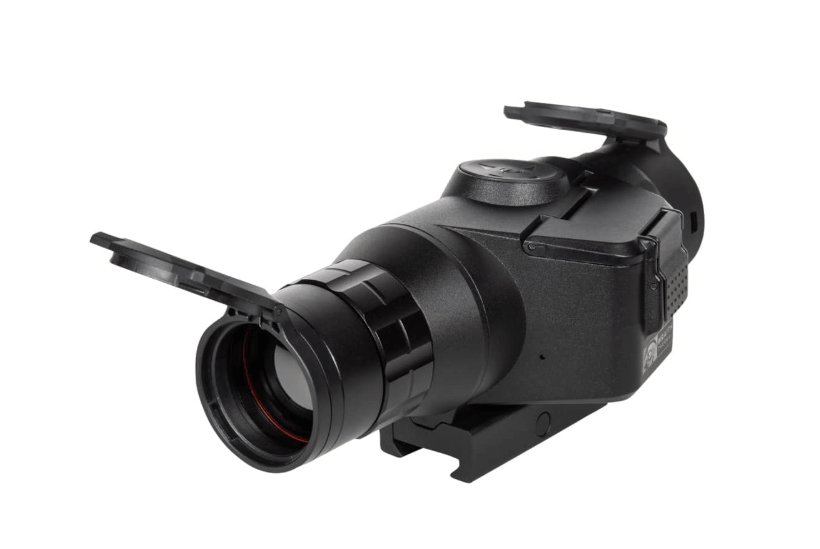
The Wraith Mini Thermal is worth considering if you want a compact thermal riflescope with more sensor pixels than the 256×192 AGM entry-level models. It is suited to buyers who value onboard recording and multiple reticle and color options.
Why Choose It
Sightmark specifies a 384×288 thermal sensor, a 2× optical base magnification, and a 35mm lens. It also includes onboard video recording, five thermal color palettes, and five weapon profiles. These features give it a different balance from the simpler AGM models.
Sightmark lists the scope at 19.3 ounces, making its body relatively light for a dedicated thermal optic. Its stated battery life is 3.5 hours in video mode or 4.4 hours in preview mode, so planning for spare batteries or external power is particularly important for extended outings.
Key Features
Thermal resolution: 384×288
Lens: 35mm
Optical base magnification: 2×
Digital zoom: 1–8×
Manufacturer-stated detection range: up to 1,400 yards
Weight: 19.3 oz
Display resolution: 1024×768 OLED
Recording: onboard video with sound
Battery life: 3.5 hours in video mode or 4.4 hours in preview mode
Water resistance: IPX6
What These Features Mean in Real Use
The 384×288 sensor provides more native pixels than a 256×192 sensor. That additional resolution can help preserve useful image detail, although actual clarity also depends on sensor sensitivity, lens performance, thermal contrast, and viewing conditions.
The 2× optical base magnification is useful when you want a relatively broad view before applying digital zoom. That can be helpful for following movement across an open area. However, the scope’s 35mm lens and higher-resolution sensor do not guarantee a particular identification distance.
Battery endurance is the main practical limitation. A maximum of 4.4 hours in preview mode is considerably shorter than the runtime advertised for the AGM Rattler V2 models. If your outings last most of the night, factor in the cost and convenience of replacement batteries or a compatible external power source.
The five weapon profiles can also be useful for storing different configurations. Nevertheless, each profile must be correctly set up and verified for the actual firearm and ammunition combination.
Trade-Offs
The Wraith Mini’s higher sensor resolution and recording features are appealing, but the shorter battery life may require additional preparation. Its published price is also higher than the listed entry-level AGM Rattler V2 prices checked for this comparison.
May Not Be Ideal If
You need long operating time from a single charge or want the lowest initial purchase cost.
Pros
384×288 thermal sensor
Compact 19.3-ounce body
Built-in recording with sound
Multiple reticles, palettes, and weapon profiles
Cons
Shorter advertised battery runtime
Higher initial price than entry-level 256×192 models
Detection range does not establish reliable identification range
Decision Summary
Best if: you want a compact thermal scope with a higher-resolution sensor and recording features.
Consider another option if: long battery life or minimum purchase cost is your top priority.
5. AGM Rattler V2 25-320
Best for moving up from entry-level sensor resolution
Best For
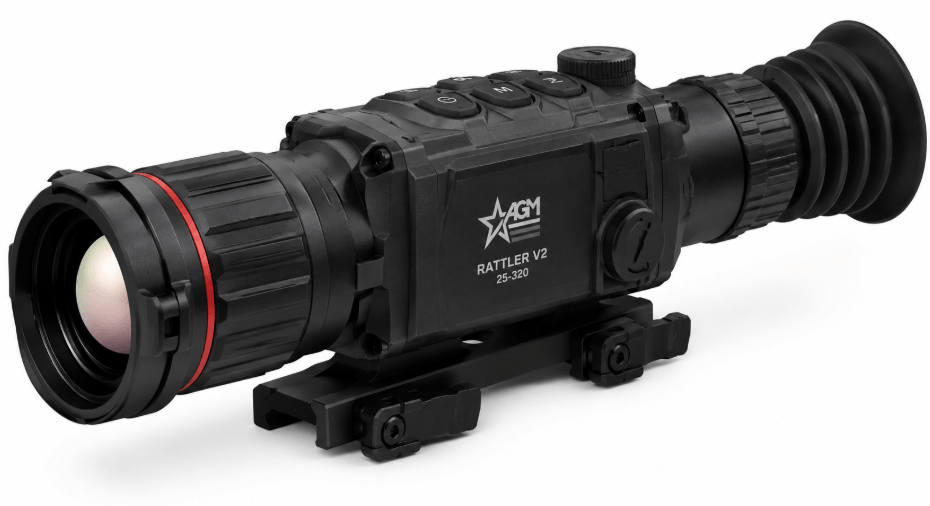
The Rattler V2 25-320 is aimed at buyers who want a step up from a 256×192 thermal sensor while staying within the Rattler V2 product family.
Why Choose It
AGM’s Rattler V2 lineup includes a 25-320 configuration with a 320×256 thermal sensor and a 25mm lens. The manufacturer lists a 3.5× base magnification and a detection range of up to 1,200 yards for this configuration. Its published specifications also list a NETD rating below 20mK, indicating greater stated thermal sensitivity than the 256-resolution models rated below 35mK.
Key Features
Thermal sensor resolution: 320×256
Lens: 25mm
Base magnification: 3.5×
Digital magnification range: 3.5×–28×
Manufacturer-stated detection range: up to 1,200 yards
NETD: less than 20mK
Refresh rate: 50Hz
Manufacturer-listed battery life: up to 6.5 hours
Thermal color palettes and onboard recording
What These Features Mean in Real Use
The 320×256 sensor offers more native image pixels than the 256×192 models. This can provide more useful detail when observing animals, particularly when combined with good thermal contrast and suitable viewing distances.
The below-20mK sensitivity rating is another specification worth considering. NETD describes the sensor’s ability to distinguish small temperature differences under specified test conditions; a lower figure can be beneficial when thermal contrast is subtle. However, neither sensor resolution nor NETD alone determines how clearly a hog can be identified in the field.
The 3.5× base magnification and 25mm lens provide a relatively tighter view than the 19-256 model. That is worth weighing against the need to scan a wide area. AGM’s listed battery runtime of up to 6.5 hours is also shorter than the 11.5-hour figures for the two 256-resolution models discussed above.
Trade-Offs
The main advantage is the move to a 320×256 sensor with a lower stated NETD. The trade-off is shorter advertised battery life, and the price must be checked against the current listing before calling it a budget bargain.
May Not Be Ideal If
You want the widest possible field of view or need the longest battery runtime for overnight use. The 19-256 model may be more practical for broad scanning, while the 25-256 offers a longer advertised runtime.
Pros
Higher sensor resolution than 256×192 models
NETD rating below 20mK
50Hz refresh rate
Multiple thermal palettes and recording functions
Cons
Shorter stated runtime than the 19-256 and 25-256
Narrower viewing angle than the 19-256 configuration
Decision Summary
Best if: you want more sensor detail than a basic 256×192 thermal scope provides.
Consider another option if: maximum battery endurance or a broad scanning view matters more.
Factors to Consider When Choosing a Budget Thermal Scope for Hog Hunting
1. Thermal Sensor Resolution
Resolution determines how many pixels form the thermal image. The models in this comparison range from 160×120 to 384×288, with the higher-resolution sensors generally providing more image detail.
A 256×192 scope may be sufficient for locating heat signatures in nearby fields. If you need to distinguish animals farther away, a 320×256 or 384×288 sensor is worth considering. However, image quality also depends on the lens, sensor sensitivity, weather, and thermal contrast.
2. Detection Range Versus Identification Range
Do not choose a scope based only on its advertised detection range. Detecting a warm object at a long distance is different from identifying it confidently as a hog.
Manufacturers often state detection distances using standardized targets. Actual identification performance depends on target size, image resolution, atmospheric conditions, and the viewer.
For a wider overview of thermal optics across different hunting applications, the best thermal rifle scope for hunting comparison provides useful context beyond hog-specific models.
3. Magnification and Field of View
Lower base magnification usually gives you a wider view, which helps when scanning fields or following movement. Higher base magnification makes the initial image larger but reduces the amount of surrounding terrain you can see.
For example, the AGM Rattler V2 19-256 starts at 2.5×, while the 25-256 starts at 3.5×. Neither is universally better; the right choice depends on how much terrain you need to monitor and how far away you expect to observe animals.
4. Thermal Sensitivity
NETD is a measure of a thermal sensor’s ability to distinguish small temperature differences under specified conditions. A lower NETD figure can be helpful when temperature differences between an animal and its background are subtle.
Nevertheless, a favorable NETD rating does not guarantee a clear image in every situation. Fog, rain, humidity, vegetation, and changes in ground temperature can all affect thermal contrast.
5. Battery Life and Power Options
Battery endurance can matter more than an extra magnification setting when you spend several hours in the field.
The AGM Rattler V2 19-256 and 25-256 are advertised for up to 11.5 hours under specified conditions, whereas the Sightmark Wraith Mini Thermal is rated for 3.5 hours in video mode or 4.4 hours in preview mode. Actual runtime varies with use and environmental conditions.
Check whether the scope uses replaceable batteries, an internal rechargeable battery, or a proprietary pack. Also confirm whether external power is supported and whether it affects how the scope can be carried or mounted.
6. Weight, Mounting, and Recoil Compatibility
A thermal scope adds weight and changes a rifle’s balance. This matters when carrying the firearm over long distances or using it from an unsupported position.
Check the complete setup, including the scope, mount, and power accessories. You should also confirm the manufacturer’s recoil rating and mounting requirements for your specific firearm before purchasing. Do not assume that every thermal scope is compatible with every rifle or cartridge.
7. Display, Controls, and Recording
A clear display and controls that are easy to operate without bright external lighting can make a thermal scope more convenient. Multiple palettes let you choose different ways to display heat, while recording can help you review observations later.
However, recording, Wi-Fi, and multiple reticles should not take priority over image quality and reliable operation if your budget is limited.
8. Total Cost and Local Availability
The purchase price is only part of the expense. Consider the correct mount, spare batteries, external power accessories, warranty support, and potential repair costs.
Before ordering, verify the exact model and current price with the retailer. If you are considering premium European thermal optics as an alternative to an entry-level model, the best Pulsar thermal scope comparison can help you understand the broader range of available features.
Frequently Asked Questions
1. What is the best budget thermal scope for hog hunting?
The AGM Rattler V2 19-256 is a reasonable starting point for buyers prioritizing a wide field of view and long advertised battery life. If you want more sensor detail, consider the Sightmark Wraith Mini Thermal or AGM Rattler V2 25-320, subject to current pricing and availability.
2. Is a 256×192 thermal scope good enough for hog hunting?
A 256×192 thermal scope can be useful for locating animals and observing them at suitable distances. However, its lower image resolution may limit identification at longer distances, particularly when thermal contrast is poor. Your intended viewing distance and terrain should guide the decision.
3. How much should I spend on a budget thermal scope?
Set your budget based on the features you genuinely need rather than a single price threshold. Entry-level 256×192 models can reduce the initial cost, while higher-resolution options may justify additional expense if image detail is important. Check current retailer prices and factor in mounting hardware, batteries, and warranty support.
Conclusion
The best budget thermal scope for hog hunting depends on whether you prioritize affordability, a wide field of view, battery endurance, or greater image detail. The AGM Rattler V2 19-256 is a practical entry-level option for scanning, while the 25-256 offers higher base magnification. The ATN ThOR LTV 160 favors generous eye relief, the Sightmark Wraith Mini Thermal provides a 384×288 sensor and recording features, and the AGM Rattler V2 25-320 offers a middle ground in sensor resolution.
Compare the exact model specifications and current prices before making your decision. Most importantly, choose a thermal optic that supports responsible animal identification at the distances you expect to observe, and verify all applicable hunting, firearm, and thermal-device regulations before use.